How tall are car lifts? Car lifts vary significantly in height, with typical two-post lifts reaching between 8 and 12 feet when fully extended, and four-post lifts often ranging from 10 to 16 feet or more. The car lift height you need depends directly on the garage height for car lift, the types of vehicles you intend to lift, and the desired storage height for those vehicles. This detailed guide will help you navigate the critical aspect of vehicle lift dimensions for your garage planning.
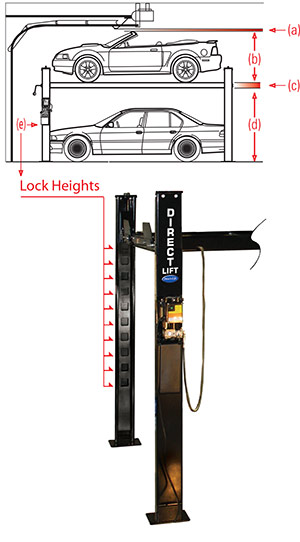
Image Source: www.mcgeecompany.com
Fathoming the Vertical Needs of Car Lifts
When you’re planning your garage for a car lift, the single most crucial factor to consider is height. It’s not just about fitting the lift; it’s about ensuring safe operation, comfortable working space, and the ability to lift your vehicles to the desired heights. Let’s delve into the specifics of car lift height and its implications.
Deciphering Two-Post Lift Height
Two-post lifts are a popular choice for home garages due to their relatively compact footprint. However, their vertical reach is a key consideration.
- Base Plate Models: These lifts typically have a lower profile, with the base of the posts resting directly on the concrete floor. The two post lift height can range from approximately 8 to 10 feet when the arms are fully extended and the vehicle is at its highest point. The overall height of the lift structure itself will be slightly less, but it’s the maximum lifting height you need to factor in.
- Above-Ground Swing Arms: Some two-post lifts feature swing arms that can be adjusted to different heights. This offers flexibility but still requires sufficient clearance above the highest point of the lifted vehicle.
- Clearance Considerations: You must account for the height of the vehicle itself plus the ground clearance the lift provides. If you plan to work underneath the vehicle, you’ll need several feet of space between the vehicle’s undercarriage and the lift arms.
Table 1: Typical Two-Post Lift Heights (Extended)
| Lift Type | Min. Extended Height (approx.) | Max. Extended Height (approx.) | Notes |
|---|---|---|---|
| Standard 2-Post | 8 feet | 10 feet | Suitable for most passenger cars; ensure headroom for working. |
| Extended 2-Post | 9 feet | 12 feet | Offers more clearance for taller vehicles or working space. |
Interpreting Four-Post Lift Height
Four-post lifts offer greater stability and are often used for vehicle storage or heavier-duty work. Their higher capacity usually correlates with a greater overall height.
- Storage and Workspace: The primary advantage of a four-post lift is its ability to stack vehicles, creating valuable storage height. This makes them ideal for enthusiasts with multiple cars or for those looking to maximize garage space.
- Variable Lifting Heights: The four post lift height can vary significantly based on the model and its intended use. Residential models might be around 10-12 feet when fully extended, while commercial-grade lifts can reach 14-16 feet or even higher.
- Ramp Options: Some four-post lifts come with optional ramps that can be extended to further accommodate longer vehicles. The height of these ramps needs to be factored into the overall vehicle lift dimensions.
Table 2: Typical Four-Post Lift Heights (Extended)
| Lift Type | Min. Extended Height (approx.) | Max. Extended Height (approx.) | Lift Capacity Range | Notes |
|---|---|---|---|---|
| Residential 4-Post | 10 feet | 12 feet | 8,000 – 10,000 lbs | Great for storing cars or light maintenance. |
| Heavy-Duty 4-Post | 12 feet | 16 feet+ | 12,000 – 30,000 lbs | Suitable for larger vehicles, trucks, and commercial applications. |
Crucial Factors Beyond Just Height
While car lift height is paramount, several other dimensions and specifications directly impact your garage planning and lift selection.
Lift Capacity: Matching the Lift to the Load
The lift capacity is the maximum weight a car lift is designed to safely hold. This is a non-negotiable safety feature.
- Vehicle Weight: You must know the Gross Vehicle Weight Rating (GVWR) of the heaviest vehicle you plan to lift. Always choose a lift with a capacity significantly higher than your heaviest vehicle’s weight to ensure a safety margin.
- Storage vs. Service: If you’re primarily using the lift for storage, you might be able to get away with a slightly lower capacity if you only plan to lift lighter vehicles. However, if you intend to perform maintenance or repairs, a higher capacity lift offers more versatility and safety.
- Future Proofing: Consider if your automotive interests might expand. Investing in a lift with a higher capacity than you currently need might save you from a costly upgrade later.
Table 3: Lift Capacity and Common Vehicle Types
| Lift Capacity (lbs) | Common Vehicle Types |
|---|---|
| 6,000 – 8,000 | Compact cars, sedans, small coupes, motorcycles |
| 8,000 – 10,000 | Most sedans, SUVs, light trucks, sports cars |
| 10,000 – 14,000 | Larger SUVs, heavier trucks, vans, some classic cars |
| 14,000+ | Heavy-duty trucks, RVs, commercial vehicles, custom builds |
Ground Clearance: The Space Beneath
Ground clearance refers to the space between the bottom of the lift’s crossbeams (or runways on a four-post) and the floor when the lift is in its lowest position.
- Low-Profile Vehicles: If you own low-slung sports cars, you’ll need a lift that can get its arms underneath without scraping the vehicle’s body kit or chassis. Some lifts offer adjustable height arms or specialized low-profile adapters.
- Floor Condition: The flatness and smoothness of your garage floor are critical. Uneven floors can prevent a lift from lowering properly or even compromise its stability. Ensure your floor is level and free of cracks or debris.
- Drive-On Height: For four-post lifts, the height of the drive-on ramps is also a factor. You need to ensure your vehicle can clear the ramps when driving onto the lift.
Overall Vehicle Lift Dimensions: Beyond the Vertical
Don’t forget to consider the horizontal dimensions of the lift and how they will fit within your garage.
- Width: This includes the width of the two posts (or four posts) and the length of the runways. Ensure there’s enough clearance on either side of the lift and the vehicles you plan to position on it.
- Depth: Consider the overall length of the lift, especially for four-post lifts where the runways extend beyond the vehicle’s wheelbase.
- Door Clearance: When driving a vehicle onto a two-post lift, you need enough space to open the car doors comfortably once it’s elevated. For four-post lifts, you need sufficient clearance in front and behind the lift to position vehicles easily.
Garage Height for Car Lift: The Ultimate Constraint
The garage height for car lift is the absolute limiting factor. You need enough vertical space to accommodate not only the maximum lifting height of the lift itself but also the height of the vehicle being lifted, plus ample working room.
Residential Garage Height Considerations
Most standard residential garages have ceiling heights ranging from 8 to 10 feet. This often limits the types of lifts and vehicles you can accommodate.
- 8-Foot Ceilings: With an 8-foot ceiling, you’re typically limited to lower-profile two-post lifts and will be able to lift most sedans and coupes only to a moderate height, leaving minimal working clearance.
- 10-Foot Ceilings: This is a more common and practical height for many residential car lifts. It allows for more versatile two-post lifts and potentially some lower-end four-post lifts, enabling better working space.
- 12-Foot Ceilings and Above: If you’re fortunate enough to have a garage with 12-foot ceilings or higher, you open up a much wider range of options, including taller two-post lifts, most four-post lifts, and the ability to stack vehicles or work on larger trucks.
Commercial Garage Height Requirements
Commercial garages and workshops often have much higher ceilings to accommodate a wider array of vehicles and lifting needs.
- Professional Workshops: These facilities frequently feature 14-foot, 16-foot, or even higher ceilings to allow for the use of heavy-duty, high-capacity lifts designed for trucks, vans, and specialized equipment.
- Stacking and Storage: The higher ceilings in commercial settings are essential for maximizing storage height and allowing for multiple vehicles to be stacked safely.
Calculating Your Required Garage Height
Here’s a practical approach to determining the garage height for car lift:
- Identify Your Target Lift: Research the maximum lifting height of the specific car lift model you are considering. This is usually listed in the manufacturer’s specifications.
- Measure Your Tallest Vehicle: Determine the overall height of the tallest vehicle you intend to lift.
- Add Desired Working Clearance: Decide how much space you want between the vehicle’s undercarriage and the lift’s crossmembers. For comfortable working, 3 to 4 feet is often recommended.
- Factor in Lift Structure: Remember that the lift itself has a physical structure that occupies space. For two-post lifts, the power unit and overhead structure (if any) will add to the overall height. For four-post lifts, the crossmembers and locking mechanisms also contribute.
Formula for Minimum Required Garage Height:
Minimum Garage Height = (Lift’s Max Lifting Height) + (Vehicle’s Height) + (Desired Working Clearance)
Example Calculation for a two-post lift:
- Lift’s Max Lifting Height (e.g., a two-post lift that lifts a vehicle 72 inches off the ground): 6 feet
- Vehicle’s Height (e.g., a standard SUV): 5.5 feet
- Desired Working Clearance: 4 feet
Minimum Garage Height = 6 ft + 5.5 ft + 4 ft = 15.5 feet
Example Calculation for a four-post lift (for vehicle storage):
- Lift’s Max Lifting Height (e.g., a four-post lift that lifts a vehicle 78 inches off the ground): 6.5 feet
- Vehicle’s Height (e.g., a sedan): 4.5 feet
- Space above stored vehicle (for clearance and aesthetics): 1 foot
Minimum Garage Height = 6.5 ft + 4.5 ft + 1 ft = 12 feet
This calculation highlights why a 10-foot garage might be sufficient for some lifting tasks but insufficient for others, especially if you want ample working room or to lift taller vehicles.
Types of Car Lifts and Their Height Implications
Let’s break down common lift types and how their vehicle lift dimensions affect garage planning.
Two-Post Lifts
- Overhead Clearance: The key measurement for two-post lifts is the overhead clearance. Many models have an adjustable hydraulic cylinder, meaning the overall height of the lift structure itself is variable. However, you must consider the height of the power unit and any overhead balance cable or beam.
- Clear Floor vs. Overhead Beam:
- Clear Floor Lifts: These have no overhead beam, making them ideal for garages with lower ceilings, as the power unit is typically mounted on one of the posts. Their maximum two post lift height is dictated by the cylinder and arm length.
- Overhead Beam Lifts: These have a beam across the top connecting the two posts. This beam houses the hydraulic cylinder and equalization cables. While they often offer higher lifting capacities and better synchronization, they require significantly more garage height for car lift.
Four-Post Lifts
- Under-Door Height: For four-post lifts, the height of the drive-on ramps is critical. You need to ensure your vehicle can clear the garage door opening and the ramps when driving onto the lift.
- Overall Height: The total height of the four-post lift structure is a fixed measurement, and this is what you must compare against your garage ceiling.
- Space Between Posts: Consider the interior width between the posts. This will determine the widest vehicle you can safely position on the lift.
Scissor Lifts
Scissor lifts are another option, often used for lower-height lifting or alignment.
- Lower Profile: Many scissor lifts can be recessed into the floor, offering a very low ground clearance and minimal obstruction when not in use.
- Lifting Height: While their maximum lifting height might be less than a tall two-post or four-post lift, they can still lift vehicles high enough for basic maintenance. Their compact design often makes them a good fit for garages with height restrictions.
Frequently Asked Questions (FAQ)
Q1: Can I install a car lift in a standard 8-foot garage?
A1: Yes, but with limitations. You’ll likely be restricted to lower-profile two-post lifts, and the maximum lifting height for your vehicles will be constrained, leaving less room for comfortable working. It’s crucial to meticulously measure your ceiling height and compare it to the specific lift’s specifications.
Q2: What is the minimum ceiling height required for a four-post lift?
A2: A general guideline for a typical residential four-post lift is a minimum of 10 feet, but 12 feet or more is highly recommended for ample working space and to accommodate taller vehicles or stack storage. Always check the specific lift’s maximum height.
Q3: How much working clearance do I need under a vehicle on a lift?
A3: For comfortable working, at least 3 to 4 feet of clearance between the vehicle’s undercarriage and the lift’s crossmembers is ideal. This allows you to move around easily, use tools, and even sit or lie on a creeper.
Q4: Does the lift capacity affect the car lift height?
A4: Generally, yes. Higher capacity lifts often have more robust structures, which can sometimes translate to a slightly greater overall height. However, the primary driver of car lift height is the intended lifting range, not necessarily the lift capacity.
Q5: What if my garage ceiling is not perfectly level?
A5: A level garage floor is essential for safe operation. If your ceiling or floor is not level, it’s highly recommended to consult with a professional installer or consider floor leveling before installing a car lift. Uneven surfaces can compromise the lift’s stability and safety.
Q6: Can I store two cars stacked vertically in a standard residential garage?
A6: It depends entirely on your garage height for car lift and the types of vehicles. You’ll need a four-post lift with sufficient storage height to raise the first vehicle high enough to clear the second vehicle when it’s parked below, plus adequate headroom. This typically requires a garage ceiling of 12 feet or more.
Conclusion: Planning for Vertical Success
Choosing the right car lift involves more than just picking a model with the desired lift capacity. The car lift height, along with overall vehicle lift dimensions, are critical planning factors. For anyone considering a residential car lift height or a commercial car lift height, meticulously measuring your garage space and understanding the specific requirements of different lift types is paramount. By carefully considering the two post lift height and four post lift height relative to your garage height for car lift, you can ensure a safe, functional, and efficient workshop that meets all your automotive needs. Prioritize safety, account for working clearance, and plan for your future automotive aspirations to make the most of your garage space.