When you press the gas pedal, you expect your car to speed up smoothly. But sometimes, you hear a strange noise instead. Why does my car make a sound when I accelerate? Different sounds point to different problems in your car’s many parts, like the engine, transmission, or exhaust system. These noises are warning signs, and finding out what they mean is important for fixing your car and staying safe.
Hearing an unusual sound when you accelerate is your car telling you something is wrong. Pinpointing the exact noise – is it a knock, a whine, a rattle, or something else? – and when you hear it helps figure out the problem. Let’s look at the common reasons your car might be making a noise when you speed up.
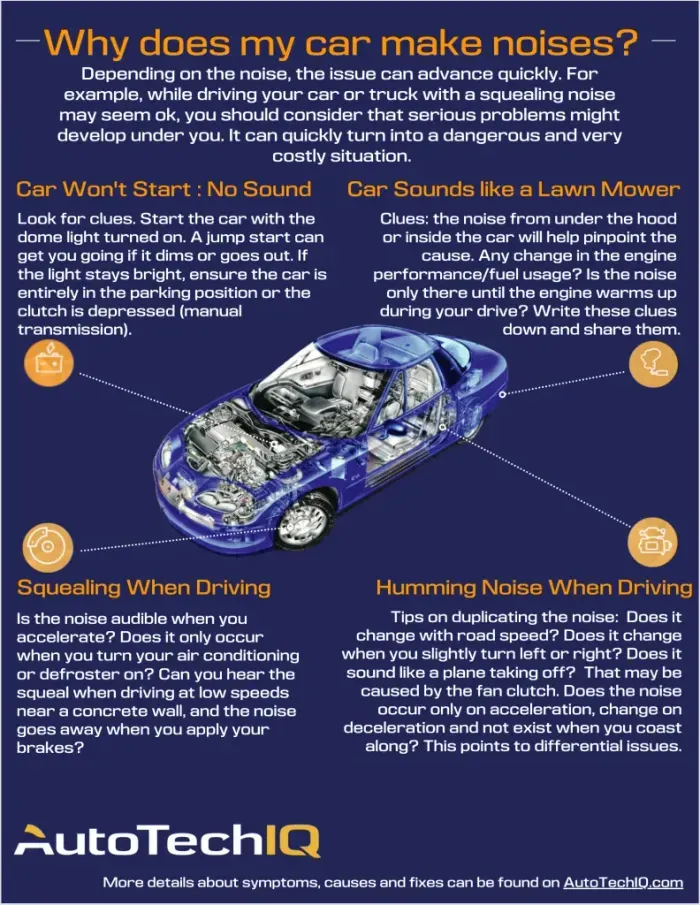
Image Source: www.autotechiq.com
Deciphering Engine Noises
The engine is the heart of your car. It makes power by burning fuel. This process should be smooth, but sometimes things go wrong and cause noises, especially under the extra work of acceleration.
Figuring Out Engine Knock or Pinging
One worrying sound is often called engine knock or engine pinging acceleration. It sounds like marbles rattling inside the engine or a light metallic tapping noise acceleration. You usually hear it when you speed up or go uphill because the engine is working harder.
h5 What Causes Engine Knock/Pinging?
This noise happens when the fuel and air mix in the engine cylinder doesn’t burn smoothly. Instead of a controlled burn, parts of the mix explode too early. This uncontrolled explosion creates pressure waves that hit the sides of the cylinder, making the knocking or pinging sound.
h5 Common Reasons for Knocking
Several things can cause this problem:
- Wrong Fuel Octane: Your car’s engine is designed to work best with a certain type of fuel, measured by octane. Using fuel with a lower octane rating than recommended can cause it to ignite too early, leading to knocking.
- Engine Running Hot: If the engine gets too hot, it can also make the fuel-air mix explode early. This could be from problems with the cooling system, like low coolant or a bad thermostat.
- Carbon Buildup: Over time, small bits of carbon can build up inside the engine cylinders and on the pistons. These hot spots can cause the fuel mix to ignite too soon.
- Timing Issues: The engine’s computer controls exactly when the spark plugs fire. If this timing is off, it can lead to knocking.
- Faulty Sensors: Sensors like the knock sensor or the engine temperature sensor tell the computer how the engine is running. If these sensors are bad, the computer might not adjust the engine correctly, causing knocks.
- Lean Fuel Mixture: If the engine gets too much air and not enough fuel (a “lean” mix), it can burn hotter and faster, leading to pinging. This can be caused by issues like fuel injector problems or vacuum leaks.
h5 Why It’s a Problem
Engine knocking noise acceleration is more than just annoying. Over time, the uncontrolled explosions can damage engine parts like the pistons and cylinders. It reduces engine power and fuel efficiency. Ignoring it can lead to expensive repairs.
h5 What To Do About It
If you hear engine pinging acceleration, especially when accelerating:
- Stop accelerating hard for now.
- If you just filled up, make sure you used the right octane fuel.
- Check your engine’s temperature gauge to see if it’s running hot.
- Have a mechanic check the issue. They can read the engine’s computer codes and inspect parts for carbon buildup, cooling system problems, or sensor faults.
Exploring Vacuum Leak Sounds
Another engine-related sound you might hear when you accelerate is a hissing or whistling noise. This could be a vacuum leak sound acceleration. Your engine uses vacuum (areas of lower pressure) for many systems, like air intake, emissions control, and even some brakes.
h5 What Causes Vacuum Leaks?
Vacuum lines are usually made of rubber or plastic hoses. Over time, these hoses can crack, break, or become loose. Gaskets that seal parts together can also fail. When this happens, unwanted air gets sucked into the system, creating a leak.
h5 Common Places for Leaks
Vacuum leaks can happen in many places:
- Intake Manifold Gaskets: Seals where the intake manifold bolts to the engine.
- Vacuum Hoses: Any of the many rubber or plastic hoses connected to the engine.
- Brake Booster: Part of the braking system, but uses engine vacuum. A leak here often affects the brakes and engine performance.
- PCV Valve/Hoses: Part of the crankcase ventilation system.
- EGR Valve Gasket: Part of the exhaust gas recirculation system.
h5 The Sound of a Leak
A vacuum leak sound acceleration is often described as:
- A hissing noise.
- A whistling sound.
- A sucking sound.
You might hear it more when the engine is running but loudest when you accelerate because the engine vacuum changes.
h5 Why It’s a Problem
A vacuum leak messes up the engine’s air-fuel mixture, usually making it run lean (too much air). This can cause:
- Rough idling (engine shakes when stopped).
- Poor acceleration.
- Engine stalling.
- Check Engine Light turning on.
- Sometimes, it can even cause engine pinging due to the lean mixture.
h5 What To Do About It
If you suspect a vacuum leak sound acceleration:
- Listen carefully to try and find where the sound is coming from.
- Visually inspect easily accessible vacuum hoses for cracks or disconnections (only when the engine is off and cool!).
- A mechanic has special tools (like a smoke machine) that can easily find vacuum leaks by pushing smoke into the system and seeing where it comes out. Getting it fixed is important for engine performance and preventing other issues.
Grasping Belt Squeal Sounds
You might hear a high-pitched squeal or screech when you start your car or when you accelerate quickly. This is often a belt squeal acceleration. These belts, like the serpentine belt or older individual belts (for the power steering, alternator, air conditioning), connect different parts of the engine and make them spin.
h5 What Causes Belt Squeal?
Belt squeal happens when a belt slips on the pulley it’s running on. This slipping creates friction and the high-pitched noise.
h5 Common Reasons for Squealing
- Loose Belt: If a belt isn’t tight enough, it can slip, especially when the component it drives (like the power steering pump during a turn or the alternator under heavy electrical load, which happens during acceleration) puts extra drag on it.
- Worn Belt: Belts get old and can become smooth, glazed, or cracked. A worn surface doesn’t grip the pulley well.
- Contamination: Oil, coolant, or other fluids on the belt or pulleys can make the belt slip.
- Bad Pulley or Tensioner: Pulleys the belt runs on or the part that keeps the belt tight (the tensioner) can wear out. A bad bearing in a pulley or a weak tensioner spring can cause slipping.
- Misaligned Pulleys: If pulleys aren’t perfectly lined up, it can cause the belt to wear unevenly and squeal.
h5 When You Hear It
Belt squeal acceleration is often loudest right when you start the engine, especially in damp weather, but it usually goes away quickly. If it squeals only when you accelerate, it means the extra effort needed for acceleration is causing the belt to slip under the added load on one of the driven accessories.
h5 Why It’s a Problem
Besides being annoying, a squealing belt is a sign it’s not working right. This can mean:
- The alternator isn’t charging the battery properly.
- The power steering might not work well.
- The air conditioning might not blow cold.
- If the belt breaks, the car can lose power steering, the battery won’t charge, and the engine might overheat if the water pump stops spinning.
h5 What To Do About It
If you hear a belt squeal acceleration:
- Have the belts inspected for wear, cracks, or glazing.
- Check the tension of the belts (or the automatic tensioner).
- Look for any fluid leaks near the belts and pulleys.
- A mechanic can check the pulleys and tensioner for wear and replace any bad parts or the belt itself. It’s usually a straightforward and not too expensive fix.
Making Sense Of Transmission Sounds
The transmission changes gears to send power from the engine to the wheels efficiently. It’s a complex system that should work quietly. Noises coming from the transmission, especially when accelerating or shifting, are definite signs of trouble.
Deciphering Transmission Whine
A common transmission sound when accelerating is a whine. It might sound like a faint electrical hum that gets louder and changes pitch as you speed up, or a distinct gear noise. You might hear a transmission whine when accelerating and decelerating, or specifically when speeding up.
h5 What Causes Transmission Whine?
Transmission whine usually comes from the gears or bearings inside the transmission wearing out or having problems.
h5 Common Reasons for Whining
- Low or Old Fluid: Transmission fluid cools and lubricates the moving parts. Low fluid levels or old, broken-down fluid can cause parts to rub incorrectly and whine.
- Worn Gears: The gears inside the transmission have teeth that mesh together. If these teeth wear down or get damaged, they can make a whining noise as they spin.
- Worn Bearings: Bearings allow parts to spin smoothly. If a bearing wears out in the transmission, it can cause a whining or growling sound.
- Torque Converter Problems (Automatic Transmissions): The torque converter transfers power from the engine to the transmission. Issues here can sometimes cause whining, especially under load.
- Planetary Gear Set Issues (Automatic Transmissions): This complex gear system is critical for changing ratios. Wear or damage here often results in whining.
- Input or Output Shaft Problems (Manual Transmissions): Bearings or gears on these shafts can cause noise if worn.
h5 When You Hear It
A transmission whine when accelerating typically gets louder as you speed up and the transmission shifts through gears. It might change pitch depending on the gear.
h5 Why It’s a Problem
Transmission problems, including whining, should not be ignored. They often mean internal wear or damage. This can lead to:
- Poor shifting performance.
- Loss of power.
- Eventually, major transmission failure, which is very expensive to fix.
h5 What To Do About It
If you hear a transmission whine when accelerating:
- Check your transmission fluid level and condition (follow your car’s manual for how to do this, as it varies). Is it low? Does it look dark or smell burnt?
- Get your car to a mechanic who specializes in transmissions. They can listen to the sound, check the fluid, and might need to inspect the transmission internally. Catching a transmission problem early can sometimes save you from needing a full rebuild or replacement.
Interpreting Grinding Sounds
A harsher sound than a whine is a grinding sound acceleration. This is often a more serious sign of metal-on-metal contact where it shouldn’t be happening.
h5 What Causes Grinding?
Grinding usually means something is severely worn or broken inside the transmission or related parts.
h5 Common Reasons for Grinding
- Severely Worn Gears/Bearings: Similar to whining, but worse wear leads to grinding.
- Synchronizer Problems (Manual Transmissions): Synchronizers help gears mesh smoothly when shifting. If they fail, shifting can be difficult and cause a grinding noise, especially during acceleration after a shift.
- Clutch Problems (Manual Transmissions): A worn-out clutch can cause grinding noises, particularly when trying to engage gears during acceleration.
- Internal Component Failure: Pieces of metal breaking off inside the transmission can cause grinding as they get caught between moving parts.
- Differential Problems: The differential, which allows wheels to spin at different speeds (often part of the transmission assembly, especially in front-wheel drive cars), can make grinding noises if its gears or bearings fail.
h5 When You Hear It
A grinding sound acceleration can happen when shifting gears, or it might be a constant noise that gets worse as you speed up. In automatic cars, it might happen during or right after a shift.
h5 Why It’s a Problem
A grinding sound acceleration is a strong indicator of significant mechanical failure within the transmission or differential. Driving with a grinding transmission can quickly cause more damage.
h5 What To Do About It
If you hear a grinding sound acceleration:
- Pull over safely as soon as possible.
- Avoid driving the car if the grinding is loud or constant.
- Have the car towed to a transmission specialist. Do not try to drive it far, as this can make the problem much worse and more expensive to fix.
Exploring Exhaust System Noises
The exhaust system routes hot gases from the engine out the back of the car and also quiets the engine noise. Damage to the exhaust system can cause different sounds, often noticeable during acceleration.
Figuring Out Exhaust Leaks
A common exhaust sound is a loud roar, hiss, or puffing noise that gets louder when you accelerate. This is likely an exhaust leak sound acceleration.
h5 What Causes Exhaust Leaks?
The exhaust system deals with hot gases and is exposed to road salt and moisture. This can cause parts to rust, crack, or break.
h5 Common Places for Leaks
Leaks can happen anywhere from the engine to the tailpipe:
- Exhaust Manifold Gasket: Seal where the exhaust manifold bolts to the engine. Heat and vibration can cause this gasket to fail.
- Pipes: Rust can eat holes in the exhaust pipes.
- Muffler or Resonator: These parts can rust through or have failed seams.
- Catalytic Converter: Can develop cracks, especially if damaged.
- Joints and Clamps: Connections between exhaust parts can rust and come loose.
h5 The Sound of a Leak
An exhaust leak sound acceleration varies based on the size and location of the leak:
- A small leak near the engine might sound like a ticking or puffing, especially when the engine is cold.
- A larger leak further back sounds like a loud roar or rumble, getting much louder during acceleration.
- Sometimes it sounds like a distinct “hiss” or “chuff” sound.
h5 Why It’s a Problem
An exhaust leak sound acceleration isn’t just annoying and loud. It can also be dangerous:
- Noise: It makes the car much louder.
- Performance: A leak before the oxygen sensor (which tells the computer how the engine is burning fuel) can trick the computer into adding too much fuel, reducing performance and fuel economy.
- Safety: Exhaust gases contain carbon monoxide, a deadly gas. Leaks, especially those near the engine or passenger cabin, can allow fumes to enter the car.
- Environmental: Leaks after the catalytic converter mean unfiltered emissions enter the air.
h5 What To Do About It
If you suspect an exhaust leak sound acceleration:
- Try to pinpoint the source of the sound when the car is parked (but use extreme caution, exhaust parts are very hot!). A visual inspection might show rust or black soot marks around a leak.
- Get it repaired promptly. Exhaust repairs often involve replacing rusted parts or welding. Fixing it restores performance, reduces noise, and most importantly, ensures safety by preventing deadly fumes from entering the cabin.
Deciphering Other Strange Sounds
Sometimes, noises during acceleration don’t come directly from the engine, transmission, or main exhaust path.
Interpreting Rattling Noises
A rattling noise car acceleration can be particularly tricky to diagnose as it can come from many places. It sounds like something loose is shaking.
h5 What Causes Rattling?
Rattles are typically caused by something vibrating that shouldn’t be, or something hitting another part.
h5 Common Reasons for Rattling
- Loose Heat Shields: Exhaust pipes have metal shields to protect nearby parts from heat. These shields can rust or come loose and rattle, especially as the exhaust vibrates more under acceleration.
- Loose Exhaust Hangers/Clamps: The exhaust system is held up by rubber hangers and connected by clamps. If these fail, the exhaust pipe can bang against the car’s body or other components.
- Something Loose in the Engine Bay or Under the Car: This could be anything from a loose bolt, a disconnected plastic trim piece, or even debris stuck somewhere.
- Catalytic Converter Problems: The honeycomb structure inside a catalytic converter can break apart. These broken pieces can rattle around inside the converter shell. This is a serious problem and can block exhaust flow.
- Suspension or Steering Components: Worn bushings, ball joints, or tie rod ends can sometimes rattle over bumps, but in rare cases, a loose component could potentially rattle under the vibrations of acceleration.
- Loose Interior or Exterior Trim: Sometimes the rattle is from something inside the car cabin or on the bodywork that becomes more noticeable due to engine vibration during acceleration.
h5 When You Hear It
A rattling noise car acceleration might be constant, or it might only happen at certain engine speeds or vibrations. Rattles from heat shields or exhaust parts are very common under acceleration because the entire system is vibrating more.
h5 Why It’s a Problem
While a rattling heat shield is mostly just annoying, other rattles can signal more significant issues:
- A rattling catalytic converter needs immediate attention as it’s failing and can cause engine problems or even a fire.
- Loose suspension/steering parts are a safety hazard.
- Any persistent rattle should be investigated.
h5 What To Do About It
If you hear a rattling noise car acceleration:
- Try to listen carefully and see if you can tell where the rattle is coming from (front, back, under the car).
- Visually inspect the exhaust system for loose hangers or shields (when cool!).
- Check under the hood and under the car for anything obviously loose.
- Have a mechanic inspect the car, especially the exhaust system and underside components, to find the source of the rattle.
Pinpointing Clicking Noises
A clicking noise car acceleration can also have several causes, depending on the specific sound and where it seems to come from.
h5 What Causes Clicking?
Clicking sounds usually mean something is hitting something else repeatedly, or a specific part is failing in a rhythmic way.
h5 Common Reasons for Clicking
- CV Axle Joint (Front-Wheel Drive Cars): A common cause of clicking during acceleration, especially when turning. If the protective boot on the CV joint is torn, dirt and water get in, causing the joint to wear out. It clicks as the worn parts articulate under power. While often louder when turning, it can sometimes be heard during straight-line acceleration, particularly under load.
- Engine Internals (Less Common): Sometimes a loud, rhythmic click could indicate an issue inside the engine, like a bad lifter or rocker arm. However, this often happens whether accelerating or not.
- Exhaust Leak (Again): A small exhaust leak, especially near the engine manifold, can sometimes sound like a fast tick or click, like a leaky faucet. It speeds up with the engine.
- Purge Valve (Normal Operation): On many modern cars, the evaporative emissions system (EVAP) has a purge valve that clicks during normal operation. This is usually quiet, but if it’s louder than normal, it could indicate an issue, although it typically doesn’t just happen only during acceleration.
- Fan or Belt Area Obstruction: Less common, but something briefly hitting a spinning fan or belt could cause a clicking sound, though this would likely be inconsistent.
h5 When You Hear It
A clicking noise car acceleration from a CV joint is usually most noticeable when turning and accelerating at the same time. Other clicking sounds might be more constant or tied directly to engine speed.
h5 Why It’s a Problem
- A clicking CV joint is a sign of failure. If it breaks completely, you will lose power to that wheel and potentially lose control of the car.
- Internal engine clicking can be a sign of internal wear or lubrication issues that need prompt attention.
- An exhaust leak causing ticking needs fixing for safety and performance reasons.
h5 What To Do About It
If you hear a clicking noise car acceleration:
- Note when and where you hear it (turning, straight, specific speed).
- Inspect the CV joint boots on front-wheel-drive cars for tears (look behind the front wheels).
- Have a mechanic diagnose the sound. They can pinpoint the source and recommend the correct repair, whether it’s a new CV axle, exhaust repair, or something else.
General Whining Noise
We discussed transmission whine, but sometimes people describe a general whining noise car acceleration that doesn’t clearly sound like it’s from the transmission.
h5 What Else Can Cause Whining?
Besides the transmission, other components that spin can make a whining noise:
- Power Steering Pump: If fluid is low or the pump is failing, it can whine, especially when turning the steering wheel. Sometimes, this whine is more noticeable when accelerating because the engine speed increases, spinning the pump faster.
- Alternator: The alternator charges the battery. Its bearings can wear out, causing a whining or growling sound that changes with engine speed.
- Accessory Pulleys: Bearings in other pulleys (like the idler pulley or tensioner pulley for the serpentine belt) can wear out and whine.
- Turbocharger (If Applicable): Turbochargers use exhaust gases to spin a turbine and force more air into the engine. A failing turbo can make a distinct whining or siren-like noise, especially under acceleration when it’s spooling up.
- Differential/Axle Bearings (Rear-Wheel Drive/All-Wheel Drive): Similar to transmission bearings, worn bearings in the differential or axle can cause a whining noise that changes with road speed (not just engine speed), but is often most noticeable when accelerating.
h5 When You Hear It
A general whining noise car acceleration that isn’t clearly the transmission might:
- Change pitch directly with engine RPM (engine accessory like alternator, power steering pump).
- Change pitch with road speed (differential/axle bearings).
- Be tied to boosting (turbocharger).
h5 Why It’s a Problem
The problem depends on the source:
- Failing power steering pump leads to loss of power steering.
- Failing alternator means the battery won’t charge, and the car will eventually die.
- Worn pulley bearings can seize and cause the belt to break.
- A failing turbo means reduced engine power and potential internal engine damage if pieces break off.
- Worn differential/axle bearings can lead to drivetrain failure.
h5 What To Do About It
If you hear a general whining noise car acceleration:
- Try to determine if the pitch changes with engine RPM or road speed.
- Check power steering fluid level (if applicable).
- Listen under the hood to try and isolate the sound while someone briefly accelerates the engine (safely, in park/neutral, ensuring car cannot move).
- Have a mechanic diagnose it. They can use a mechanic’s stethoscope to listen to specific components like the alternator, power steering pump, and pulleys to find the source of the whine.
General Grinding Sound
Just like whining, a grinding sound acceleration can also come from areas outside the transmission.
h5 What Else Can Cause Grinding?
- Brakes: Sometimes, worn brake components can make a grinding sound, even when not actively braking. A warped rotor or a partially seized caliper might cause pads to lightly rub the rotor, which becomes more noticeable due to car vibrations during acceleration. If you hear grinding while braking and accelerating, suspect brakes.
- Wheel Bearings: A bad wheel bearing usually makes a humming or grinding sound that changes with road speed and might get louder when turning. While tied to speed, it can be heard during acceleration because you are increasing speed.
- CV Joint (Severe Failure): A severely failed CV joint that has gone beyond clicking might start grinding.
- Differential/Axle (Severe Wear): Advanced wear in the differential or axle can progress from a whine to a grind.
h5 When You Hear It
A grinding sound acceleration that isn’t the transmission might:
- Change with road speed.
- Be affected by turning.
- Also be present or worsen when braking.
h5 Why It’s a Problem
Grinding sounds from these sources are usually serious and mean mechanical parts are failing.
- Worn brakes are a major safety hazard.
- Failed wheel bearings can cause a wheel to seize or even come off.
- Severe drivetrain grinding means parts are about to fail.
h5 What To Do About It
If you hear a grinding sound acceleration:
- Try to figure out if it’s related to road speed, turning, or braking.
- Have a mechanic inspect the brakes, wheel bearings, and drivetrain components immediately.
Putting It Together: When You Hear a Noise
Hearing a noise during acceleration needs your attention. Here’s a summary of common sounds and possible causes:
| Sound Type | Potential Causes | Severity (Generally) | What to Check/Do |
|---|---|---|---|
| Knock/Pinging | Low octane fuel, hot engine, carbon, timing, lean mix | Moderate to High | Fuel type, temp gauge, see mechanic for diagnosis |
| Whine | Transmission fluid/wear, power steering, alternator, pulleys, turbo, differential | Moderate to High | Check fluids, listen closely, see mechanic |
| Grinding | Transmission wear/failure, brakes, wheel bearing, CV joint, differential | High | Stop driving if severe, see mechanic immediately |
| Hiss/Whistle | Vacuum leak | Moderate | Inspect hoses, see mechanic for leak test |
| Roar/Puffing | Exhaust leak | Moderate | Inspect exhaust, get repaired for safety/noise |
| Rattling | Loose heat shield, exhaust hangers, loose parts, catalytic converter | Low to High (Cat) | Look for loose items, see mechanic for diagnosis |
| Clicking | CV joint, small exhaust leak, purge valve, internal engine (less common) | Moderate to High (CV) | Inspect CV boots, note when it happens, see mechanic |
| Squeal | Loose/worn belts, bad pulley/tensioner | Moderate | Inspect belts, check tension, see mechanic |
Note: This table provides general guidance. Any new or unusual noise should be checked by a qualified mechanic.
What to Do When Your Car Makes a Noise During Acceleration
- Identify the Sound: Listen carefully. Is it a whine, a rattle, a knock, a grind, a hiss, or a squeal?
- Note When It Happens: Does it happen only when accelerating hard, or even light acceleration? Does it change with engine speed or road speed? Does it happen when turning? When the engine is cold or hot?
- Note Where It Comes From: Can you tell if it’s from the front, back, under the car, or under the hood?
- Check Simple Things (Safely): Check fluid levels (engine oil, transmission fluid, power steering fluid, coolant). Look for obvious loose belts or exhaust parts (only when the car is cool and off!).
- Don’t Ignore It: Most noises that happen specifically during acceleration are signs of a problem that is likely to get worse.
- See a Mechanic: This is the most important step. Explain the sound you hear, when it happens, and where you think it’s coming from. A mechanic has the tools and expertise to correctly diagnose the issue and fix it before it causes more damage or becomes a safety hazard.
Ignoring a strange noise when accelerating is risky. A minor issue like a loose belt or small exhaust leak is relatively cheap to fix. But if that noise is from a failing transmission, a bad catalytic converter, or a worn CV joint, waiting can turn a repair into a much more expensive replacement or even cause a breakdown.
Frequency Asked Questions
h4 Why does my car only make a noise when I accelerate?
Noise often happens during acceleration because this is when the engine and transmission are under the most load (working hardest). This puts extra stress on components, making existing problems like worn bearings, slipping belts, exhaust leaks, or pre-ignition (pinging) more noticeable. Parts that are slightly loose or worn might only vibrate enough to make noise when the engine or drivetrain is working hard.
h4 Is it safe to drive if my car makes a noise when accelerating?
It depends on the noise. A slight belt squeal or a faint exhaust leak might be safe for a short time, but should still be fixed soon. However, noises like loud grinding, persistent knocking/pinging, or a severe rattle (especially from under the car or near the engine) can indicate serious problems. Driving with these sounds could cause more damage or be unsafe. It’s best to have any worrying noise checked by a mechanic as soon as possible.
h4 Can low oil cause a noise when accelerating?
Yes, low engine oil can potentially cause noises, though typically not just only when accelerating. Very low oil can lead to lack of lubrication, causing parts within the engine to make ticking, tapping, or knocking sounds due to excessive wear or friction. These sounds are often present at idle but might become louder under acceleration as the engine works harder. Always check your oil level regularly.
h4 Could the noise be from my tires or brakes?
Less commonly, but possible. A damaged tire (like a separating tread) can make sounds related to road speed, which increases during acceleration. Worn brake pads (especially if they have wear indicators) can sometimes make a squealing or grinding sound that is more noticeable at certain speeds, even when not braking, and might seem louder during acceleration due to increased vibrations. However, engine, transmission, and exhaust issues are more frequent causes of noises heard specifically while accelerating.
h4 How much will it cost to fix a noise when accelerating?
The cost varies greatly depending on the source of the noise.
* A simple belt replacement or tightening might be under $100.
* Fixing a vacuum leak could be $100-$300 depending on the location and part.
* Exhaust repairs can range from $100 for a clamp/hanger to $500+ for a pipe or muffler section, and over $1000 for a catalytic converter.
* CV axle replacement is typically $200-$600 per axle.
* Engine knocking/pinging diagnosis and repair (e.g., cleaning carbon, fixing a sensor) could be several hundred dollars.
* Transmission repairs are often the most expensive, ranging from $500-$1500 for minor fixes or fluid services, to $2000-$5000 or more for a rebuild or replacement.
Getting a mechanic to diagnose the specific noise is the first step to getting an accurate cost estimate.
In Conclusion
Unusual noises when you accelerate are your car’s way of asking for help. While some sounds might be minor, many point to issues that need prompt attention to prevent bigger problems, ensure safety, and keep your car running reliably. Pay attention to the sound, when it happens, and where it comes from. Don’t delay in having a qualified mechanic check it out. Fixing the issue early will give you peace of mind and protect your investment.