Image Source: www.ufinebattery.com
Can You Use A Boat Battery In A Car? Pros & Cons
Yes, in some situations, you can use a boat battery in a car, but it’s generally not recommended due to significant differences between the two types of batteries. While a marine battery car swap might seem like a quick fix, it comes with a host of pros and cons that are crucial to consider before making the switch. This article will delve into the specifics of using a boat battery for car starting, comparing a car battery vs boat battery, and exploring the nuances of a boat battery car swap.
Fathoming the Differences: Car Battery vs. Boat Battery
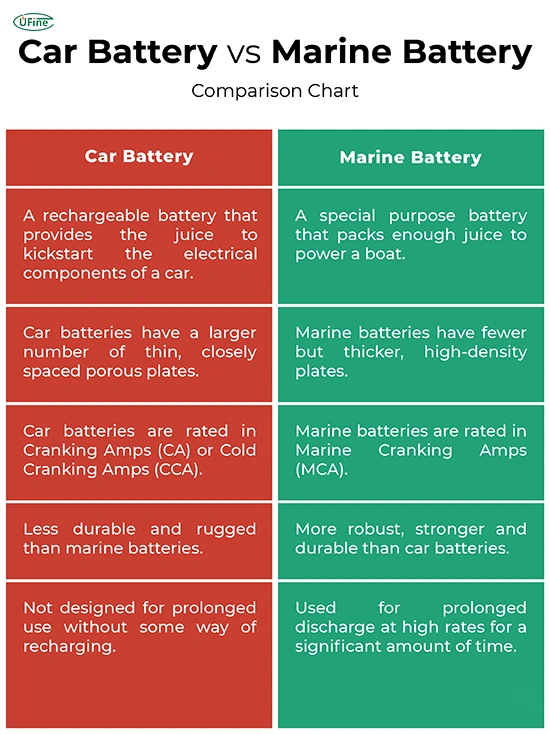
At first glance, both car batteries and boat batteries look similar. They are lead-acid batteries designed to provide electrical power. However, their internal construction and intended use lead to distinct performance characteristics.
Car Batteries (Starting Batteries):
- Primary Purpose: To deliver a quick, high burst of power to crank the engine. This is known as the Cold Cranking Amps (CCA) rating.
- Construction: Designed for short, powerful discharges. They have many thin lead plates to maximize surface area for rapid chemical reactions.
- Discharge Cycle: Optimized for repeated, shallow discharges followed by rapid recharging by the alternator. They are not designed to be discharged deeply and then recharged.
- Vibration Resistance: Built to withstand the typical vibrations encountered in a car’s engine bay.
Boat Batteries (Marine Batteries):
Boat batteries are typically categorized into two main types: starting (or cranking) batteries and deep cycle batteries.
- Marine Starting Batteries: These are very similar to car starting batteries in their design and purpose. They provide a powerful burst of energy to start the boat’s engine. If you’re considering a boat battery car swap, you’d ideally be looking at a marine starting battery.
- Marine Deep Cycle Batteries: These are the most common type of boat battery and are fundamentally different from car batteries.
- Primary Purpose: To provide a steady, continuous supply of power over extended periods for onboard electronics (like navigation systems, lights, stereos, trolling motors).
- Construction: Feature thicker, more robust lead plates. This design allows them to withstand repeated deep discharges and recharges without significant damage or loss of capacity.
- Discharge Cycle: Designed for slow, sustained power delivery. Discharging them deeply is their intended function.
- Vibration Resistance: Often built with greater vibration resistance to handle the constant movement and jolting experienced on water.
Can I Use a Marine Battery in My Car? Examining the Possibilities
The core question is whether you can interchange these battery types. The answer is nuanced.
Using a Marine Starting Battery in a Car:
If you have a marine starting battery, it is essentially a car battery designed for a boat. Therefore, yes, you can generally use a marine starting battery in a car. The CCA rating will be the primary factor to match. A marine starting battery will likely have a CCA rating similar to or higher than a standard car battery.
Using a Marine Deep Cycle Battery in a Car:
This is where things get tricky. Can I use a marine deep cycle battery in my car for starting? Technically, yes, but it’s highly inadvisable and will likely lead to premature battery failure. Here’s why:
- Insufficient Cranking Power: While a deep cycle battery can provide a lot of power, it’s designed for sustained delivery, not the quick, high-amperage surge needed to start a car engine. It may struggle to provide enough CCA to reliably crank your engine, especially in cold weather.
- Damage from Deep Discharges: Car alternators are designed to keep the battery topped up and do not typically discharge a car battery deeply. Using a deep cycle battery in a car means it will likely be subjected to shallow discharges and rapid recharges, which is the opposite of what it’s designed for. This can lead to sulfation and irreversible damage, significantly shortening its lifespan.
- Overcharging Risk: Car alternators regulate voltage differently than the chargers typically used for deep cycle batteries. This can lead to overcharging, which can damage the deep cycle battery.
The Boat Battery Car Swap: What to Consider
If you’re contemplating a boat battery car swap, especially with a deep cycle marine battery, here are the key pros and cons to weigh.
Pros of Using a Boat Battery in a Car:
- Potentially Higher Reserve Capacity (Deep Cycle): If you choose a deep cycle marine battery, it can theoretically provide longer periods of power for accessories if your car’s electrical system is modified to support it or if you’re using it as an auxiliary power source. However, this is a niche application for most car owners.
- Durability and Vibration Resistance: Marine batteries, especially deep cycle ones, are often built to be more robust and withstand greater vibration than standard car batteries. This could be a benefit in vehicles that experience very rough terrain.
- Availability (in a pinch): If your car battery dies and you happen to have a functional marine starting battery available, it might serve as a temporary replacement.
Cons of Using a Boat Battery in a Car:
- Cost: Marine batteries, particularly deep cycle types, are generally more expensive than comparable car batteries. You might be paying for features you don’t need or can’t fully utilize in a car application.
- Weight: Deep cycle batteries tend to be heavier due to their thicker plates. This extra weight is unnecessary for a car and can impact fuel economy slightly.
- Incorrect Discharge Profile: As mentioned, deep cycle batteries are not designed for the rapid, high-amp discharge needed for starting. Using a boat battery for car starting, especially a deep cycle one, can lead to a weak start or no start at all.
- Reduced Lifespan: The primary reason against using a deep cycle car battery (which is essentially what a marine deep cycle is) in a car is the reduced lifespan. Car charging systems and usage patterns are not optimized for deep cycle batteries. They will likely fail much sooner than a dedicated car battery.
- Potential for Overcharging: The car’s alternator may not properly manage the charging of a deep cycle battery, potentially leading to overheating and damage.
- Incorrect Terminal Placement/Size: While not universal, some marine batteries might have different terminal types or configurations that may not fit standard car battery terminals or cables.
Comprehending the Metrics: CCA, CA, and Reserve Capacity
When choosing a battery, understanding its specifications is paramount.
| Battery Type | Primary Purpose | Key Metric(s) | Typical Application |
|---|---|---|---|
| Car Battery | Engine Starting | Cold Cranking Amps (CCA) | Quick bursts of power for starting internal combustion engines |
| Marine Starting | Engine Starting | Cold Cranking Amps (CCA) | Starting boat engines |
| Marine Deep Cycle | Sustained Power, Auxiliaries | Reserve Capacity (RC), Ampere-Hours (Ah) | Powering electronics on boats (lights, trolling motors) |
- Cold Cranking Amps (CCA): This is the most critical rating for starting a car. It indicates the number of amps a battery can deliver at 0°F (-18°C) for 30 seconds while maintaining a voltage of at least 7.2 volts. A higher CCA means better starting power, especially in cold weather.
- Cranking Amps (CA): Similar to CCA, but measured at 32°F (0°C).
- Reserve Capacity (RC): This rating measures how long a fully charged battery can deliver 25 amps at 80°F (27°C) before its voltage drops below 10.5 volts. This is the primary metric for deep cycle batteries, indicating their ability to sustain power.
Deciphering the “Boat Battery in Vehicle” Scenario
So, can you use a boat battery in a vehicle? Let’s break down specific scenarios:
Scenario 1: Using a Marine Starting Battery in a Car
This is the most feasible scenario for a boat battery car swap.
- Pros:
- Similar performance to a car starting battery.
- Can provide adequate cranking power if CCA matches or exceeds the car’s requirement.
- Often built for better vibration resistance.
- Cons:
- Can be more expensive than a dedicated car battery.
- May have different terminal configurations.
- Still a marine product, not specifically optimized for car alternator charging profiles.
Recommendation: If you have a marine starting battery readily available and its CCA rating is sufficient for your car, it can serve as a temporary replacement. For long-term use, a dedicated car battery is still the better choice.
Scenario 2: Using a Marine Deep Cycle Battery in a Car for Starting
This is where problems arise. Using a marine deep cycle car use for starting is a bad idea.
- Pros:
- (Very limited) It might have enough power to start your car on a good day.
- Excellent for powering accessories if you have a custom setup.
- Cons:
- Inadequate CCA for reliable starting: It likely won’t have enough power to crank the engine effectively, especially in cold temperatures.
- Rapid degradation: The car’s charging system will likely damage the deep cycle battery, shortening its lifespan dramatically.
- Risk of being stranded: You might find yourself unable to start your car when you need it most.
Recommendation: Absolutely avoid using a marine deep cycle battery for car starting. It’s like trying to use a sprinter’s energy for a marathon – the wrong tool for the job.
Scenario 3: Using a Marine Deep Cycle Battery as an Auxiliary Battery in a Car
This is a more appropriate use case for marine deep cycle car use.
- Application: If you have a car with significant aftermarket electronics (high-powered stereo, extra lighting, refrigerators), you might consider a separate deep cycle battery to power these accessories without draining the main starting battery.
- Pros:
- Provides sustained power for accessories.
- Can handle deep discharges without significant damage.
- Cons:
- Requires a proper dual-battery isolation system to prevent overcharging the deep cycle battery and to ensure the starting battery is always ready.
- Adds weight and complexity to the vehicle’s electrical system.
- Adds cost.
Recommendation: If you need auxiliary power, a deep cycle battery is the correct choice, but it must be installed with the appropriate charging and isolation management system.
Is a Deep Cycle Car Battery a Good Idea?
The term “deep cycle car battery” is somewhat of a misnomer. While some batteries are marketed as “dual-purpose” and aim to bridge the gap between starting and deep cycle, a true deep cycle car battery in the sense of a marine deep cycle battery is generally not a good idea for primary car starting.
Dual-Purpose Batteries: These batteries are designed to offer a compromise. They have enough CCA to start an engine and enough reserve capacity to power accessories for a short time. They are a better option than a pure deep cycle battery for certain vehicles with higher accessory loads but are still not as specialized as dedicated starting or deep cycle batteries.
Comparing Starter vs. Marine Batteries: A Deeper Dive
Let’s look at the core differences between a car starter battery vs marine starting battery and a marine deep cycle battery.
Car Starter Battery vs. Marine Starting Battery:
| Feature | Car Starter Battery | Marine Starting Battery |
|---|---|---|
| Primary Role | Engine starting (quick, high current) | Engine starting (quick, high current) |
| Plate Design | Thin, numerous plates for maximum surface area | Similar to car starter batteries |
| CCA Rating | Varies by vehicle, typically 350-800+ CCA | Varies, often comparable to car starter batteries |
| Discharge | Designed for shallow discharges, rapid recharge | Designed for shallow discharges, rapid recharge |
| Vibration | Designed for car engine bay vibrations | Often designed for higher vibration resistance |
| Cost | Generally lower | Can be slightly higher |
Car Starter Battery vs. Marine Deep Cycle Battery:
| Feature | Car Starter Battery | Marine Deep Cycle Battery |
|---|---|---|
| Primary Role | Engine starting (quick, high current) | Sustained power for electronics (slow, steady discharge) |
| Plate Design | Thin, numerous plates | Thicker, fewer plates for durability under deep discharge |
| CCA Rating | High | Often lower or absent |
| Discharge | Designed for shallow discharges | Designed for deep discharges |
| Lifespan | Optimized for car use | Optimized for marine use; reduced lifespan in car starting |
| Cost | Generally lower | Generally higher |
| Weight | Lighter | Heavier |
Practical Implications of Using a Boat Battery in a Car
If you find yourself needing to use a boat battery in vehicle situation, here are some practical things to keep in mind:
- Check the CCA: Always ensure the battery you are considering has a CCA rating that meets or exceeds your car’s requirement. This information is usually found in your car’s owner’s manual.
- Terminal Compatibility: Verify that the battery terminals (post types, orientation) match your car’s battery cables. Adapters can sometimes be used, but a direct fit is ideal.
- Physical Fit: Ensure the battery physically fits into the battery tray and that the hold-down mechanism can secure it properly. Boat batteries can sometimes be larger or have different dimensions.
- Charging System Compatibility: Be aware that your car’s alternator is designed to charge a standard car battery. While it will likely charge a marine starting battery, it’s not ideal for a deep cycle battery.
- Ventilation: Batteries release gases, especially when charging. Ensure the battery is properly vented, particularly if it’s an internal component of the vehicle.
Can I use a marine battery in my car for a short period?
Yes, you can use a marine starting battery in your car for a short period, as it functions similarly to a car starting battery. However, using a marine deep cycle battery for starting your car is not advisable, even for a short duration, due to potential damage and insufficient cranking power.
Frequently Asked Questions (FAQs)
Q1: Will a boat battery damage my car?
A marine starting battery is unlikely to damage your car if its CCA rating is sufficient. However, a marine deep cycle battery, if used for starting, can lead to a weaker start and potentially shorten the lifespan of your starter motor due to insufficient cranking power. The battery itself is more likely to be damaged by the car’s charging system.
Q2: Can I use a boat battery for my car’s accessories?
A marine deep cycle battery is excellent for powering car accessories, but it requires a proper setup with a dual-battery system and isolator to prevent draining your main starting battery and to manage charging effectively. Simply connecting a deep cycle battery to your car’s accessory circuit without proper management is not recommended.
Q3: What’s the difference between a “dual-purpose” battery and a deep cycle battery?
A dual-purpose battery is designed to offer a compromise between starting power (like a car battery) and sustained power delivery (like a deep cycle battery). While they can start an engine and run accessories for a while, they are not as robust for deep discharges as a dedicated deep cycle battery and may not offer the highest CCA.
Q4: My boat battery died, can I use my car battery in my boat?
Generally, yes, you can use a car battery in a boat for starting, especially if it’s a marine starting battery. However, a car battery is not designed for the prolonged use of trolling motors or extensive electronic loads that a deep cycle marine battery handles well. Using a car battery for these purposes will significantly shorten its lifespan.
Q5: How do I know if a marine battery has enough CCA for my car?
Check your car’s owner’s manual or the label on your current car battery for the recommended CCA rating. Then, look for a marine battery that meets or exceeds this specification. Remember, a marine deep cycle battery’s primary rating is Reserve Capacity, not CCA, making it unsuitable for primary starting.
In conclusion, while a marine starting battery can sometimes be a substitute for a car battery, using a marine deep cycle battery in a car for starting is a compromise that will likely lead to disappointment and premature battery failure. For optimal performance and longevity, always use the battery type that is specifically designed for your vehicle’s intended use.