Can a police officer search your car without consent? Generally, no, but there are several important exceptions to this rule. Knowing these exceptions is crucial to understanding your constitutional rights regarding search and seizure. This article will delve into vehicle search laws, explaining when a warrantless search might be permissible and what constitutes an illegal search.
The ability of law enforcement to search your vehicle is governed by the Fourth Amendment of the U.S. Constitution, which protects citizens from unreasonable searches and seizures. While this amendment is a cornerstone of individual liberty, its application to vehicles is more complex than to homes due to the mobility of cars. This mobility creates unique circumstances where the usual requirement for a warrant may be waived.
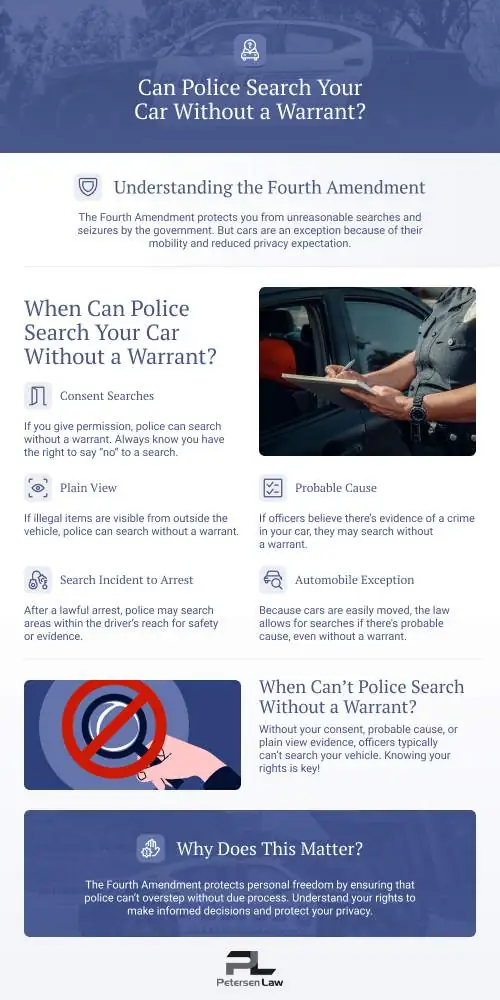
Image Source: www.criminaldefensene.com
The Foundation: The Fourth Amendment and Your Car
The Fourth Amendment is the bedrock of your protection against government intrusion into your privacy. It states: “The right of the people to be secure in their persons, houses, papers, and effects, against unreasonable searches and seizures, shall not be violated, and no Warrants shall issue, but upon probable cause, supported by Oath or affirmation, and particularly describing the place to be searched, and the persons or things to be seized.”
When it comes to cars, the Supreme Court has recognized that vehicles are different from homes. Because a car can be quickly moved, law enforcement officers often don’t have the luxury of obtaining a warrant before a search, especially if they have a valid reason to believe evidence of a crime might be found within. This leads to the concept of the “automobile exception” to the warrant requirement.
When Consent is Not Required: Key Exceptions
While consent is the simplest way for police to legally search your car, it’s far from the only way. The courts have carved out several significant exceptions to warrant requirements that allow for vehicle search laws to be applied in practice.
1. Probable Cause: The Cornerstone of a Warrantless Search
The most significant exception allowing a warrantless search of a vehicle hinges on probable cause. What exactly is probable cause? It’s a legal standard that requires law enforcement to have a reasonable belief, based on specific and articulable facts, that a crime has been committed or that evidence of a crime will be found in the place to be searched.
- What constitutes probable cause for a car search?
- The smell of illegal drugs emanating from the vehicle.
- Visible contraband (e.g., a bag of marijuana on the passenger seat).
- Information from a reliable informant indicating illegal activity or contraband in the car.
- The driver or a passenger acting suspiciously or admitting to possessing illegal items.
- Evidence of a crime observed in plain view (e.g., a weapon, drug paraphernalia).
If an officer has probable cause to believe your car contains evidence of a crime, they can typically search the entire vehicle, including the trunk and any containers within it that might hold the contraband. This is a crucial aspect of vehicle search laws.
2. Plain View Doctrine
This doctrine is closely related to probable cause. If an officer is lawfully in a place (like standing outside your car window) and sees something illegal in plain view inside the vehicle, they can seize it and may have grounds for a broader search.
- Examples of plain view contraband:
- An open container of alcohol in a vehicle driven by someone under the legal drinking age.
- Drug paraphernalia visible on the dashboard.
- A weapon visible in the passenger seat.
The key here is that the officer must be lawfully positioned to observe the item.
3. Search Incident to Lawful Arrest
If you are lawfully arrested while you are in or within reaching distance of your vehicle, police can search your car. However, this search is generally limited to the area that you could have accessed at the time of the arrest and for the purpose of finding weapons or evidence that you might have concealed or destroyed.
- Evolving standards: The Supreme Court has refined this rule over time. Now, police can search the passenger compartment of a vehicle incident to a recent occupant’s arrest only if it is reasonable to believe that the arrestee could access the vehicle at the time of the search or that the vehicle contains evidence of the offense for which the person was arrested.
This is a complex area, and officers must adhere to specific guidelines to ensure the search is not deemed an illegal search.
4. Inventory Search
If your car is lawfully impounded by the police (for example, if you are arrested and no one else is present to take the car, or if the car is evidence of a crime), they can conduct an inventory search. This search is not for the purpose of finding evidence of a crime but rather to catalog the contents of the vehicle for safekeeping.
- Purpose of inventory searches:
- To protect the owner’s property while it is in police custody.
- To protect the police from claims of lost or stolen property.
- To protect the police from potential danger.
Inventory searches must be conducted according to standardized departmental policies. An inventory search cannot be used as a pretext to conduct a general search for evidence without probable cause.
5. Reasonable Suspicion: A Lesser Standard for Temporary Detainment
While probable cause is generally needed for a full search, reasonable suspicion is enough to justify a brief detention and a limited pat-down of your car’s accessible areas for weapons if the officer has a specific and articulable reason to believe you are armed and dangerous.
- What is reasonable suspicion? It’s a lower standard than probable cause. It means an officer has a particularized and objective basis for suspecting legal wrongdoing.
- Examples of reasonable suspicion:
- Your vehicle matches the description of a car involved in a recent crime.
- You are driving erratically, indicating impairment.
- The officer sees you handing something discreetly to a passenger, or vice versa, in a high-crime area.
If an officer has reasonable suspicion that you are involved in criminal activity, they can pull you over (a pretextual stop is a stop made for a minor infraction to investigate a more serious crime, which is legal as long as the minor infraction is real). During this stop, if they develop probable cause, they can expand their search.
6. Consent: The Easiest Way (But You Can Refuse)
The most straightforward way for police to search your car without a warrant is with your consent. If you give an officer permission to search your vehicle, they can do so.
- Key points about consent:
- Consent must be voluntary and intelligent. You cannot be coerced or threatened into giving consent.
- You have the right to refuse consent. If an officer asks to search your car and you say no, they generally cannot search it unless they have probable cause or another exception applies.
- Anyone with apparent authority over the vehicle can give consent. For example, if you’re driving a friend’s car and the police have reasonable suspicion to search, your friend (the owner) might be able to give consent.
It’s important to remain calm and polite. If asked to consent, you can state clearly, “Officer, I do not consent to a search of my vehicle.”
7. Border Searches and Checkpoints
At international borders and at sobriety or immigration checkpoints, the rules are different. Law enforcement has greater authority to search vehicles without probable cause or reasonable suspicion.
- Border searches: Vehicles can be searched at the border or its functional equivalent without a warrant or probable cause because of the inherent sovereign interest in controlling who and what enters the country.
- Checkpoints: Properly established checkpoints (like sobriety checkpoints) are considered constitutional if they are implemented with specific guidelines designed to minimize the intrusion on drivers and are conducted in a non-discriminatory manner. At such checkpoints, officers can briefly detain drivers and may ask for documents. If they develop reasonable suspicion or probable cause during this interaction, further searches may be permissible.
What Constitutes an Illegal Search?
A search conducted without a warrant and without falling under any of the established exceptions to warrant is considered an illegal search. If your constitutional rights were violated during a vehicle search, any evidence found as a result of that search may be inadmissible in court under the “exclusionary rule.”
- When a search might be illegal:
- An officer searches your car based solely on a hunch or a feeling, without any probable cause or reasonable suspicion.
- You refuse consent, and the officer proceeds to search your car without any other legal justification.
- An inventory search is conducted in a way that clearly indicates it’s a search for evidence, not a genuine inventory.
- An arrestee is searched incident to arrest, but the search extends to areas the arrestee could not possibly reach.
Your Rights During a Traffic Stop
When pulled over by police, it’s essential to know your rights and how to conduct yourself.
What to Do During a Traffic Stop:
- Pull over safely: As soon as you see flashing lights, signal and pull over to a safe location.
- Stay in your car: Do not exit your vehicle unless instructed to do so by the officer.
- Keep hands visible: Place your hands on the steering wheel where the officer can see them.
- Be polite and respectful: Answer the officer’s questions truthfully and politely.
- Provide required documents: Have your driver’s license, registration, and proof of insurance readily available.
- Do not volunteer information: You are generally only required to provide information that is requested by the officer.
- Do not consent to a search: As discussed, you have the right to refuse consent to a vehicle search. You can politely state, “I do not consent to a search of my vehicle.”
What NOT to Do:
- Do not argue with the officer: Save any disagreements for court.
- Do not make sudden movements: This can be misinterpreted as a threat.
- Do not try to hide anything: This can be seen as an attempt to obstruct justice.
- Do not physically resist: This will lead to additional charges.
The Role of Pretextual Stops
A pretextual stop occurs when an officer pulls you over for a minor traffic violation (like speeding or a broken taillight) with the ulterior motive of investigating a more serious crime for which they lack probable cause. While the initial stop might be based on a minor infraction, the officer can still investigate further if they develop reasonable suspicion or probable cause during the course of the stop. The legality of pretextual stops has been upheld by the Supreme Court, meaning that as long as there is a legitimate legal reason for the stop, the officer’s underlying motive is often irrelevant to the legality of the stop itself.
What if Your Car is Searched Illegally?
If you believe your vehicle was searched illegally, it is crucial to consult with a legal professional immediately.
Key Actions to Take:
- Document everything: Write down all details of the encounter as soon as possible, including the date, time, location, officer’s badge number (if possible), what was said, and what happened.
- Preserve any evidence: If any items were seized, try to remember what they were.
- Hire an attorney: An experienced criminal defense attorney can evaluate the circumstances of the search and determine if your constitutional rights were violated. They can file a motion to suppress the evidence found during the illegal search, which could lead to the charges being dismissed.
Common Misconceptions About Vehicle Searches
It’s important to dispel some common myths surrounding vehicle search laws.
- Myth: If you have nothing to hide, you have nothing to fear.
- Reality: While this may seem logical, the Fourth Amendment protects everyone’s privacy, regardless of whether they have anything to hide. The law requires officers to have a legal basis for searches to prevent arbitrary government intrusion.
- Myth: An officer can always search your car if they smell marijuana.
- Reality: In some jurisdictions, the odor of marijuana alone may no longer constitute probable cause for a search, especially in states where marijuana is legal for medicinal or recreational use. However, this can vary greatly by state and local law. It’s a rapidly evolving area of law.
- Myth: If you’re pulled over, you must allow the officer to search your car.
- Reality: Unless the officer has probable cause, a warrant, or you give consent, you are not required to permit a search.
Table: When Police Can Search Your Car Without Consent
| Justification for Search | Legal Standard Required | What it Entitles Officers to Search |
|---|---|---|
| Probable Cause | Reasonable belief of evidence of crime | Entire vehicle, trunk, and containers within that might hold the evidence. |
| Plain View | Lawfully positioned, item is contraband | The contraband itself, and potentially further search based on what is seen. |
| Search Incident to Lawful Arrest | Arrestee is a recent occupant | Passenger compartment if arrestee could access it, or if evidence of the crime is likely present. |
| Inventory Search | Vehicle is lawfully impounded | Entire vehicle to catalog contents according to departmental policy. |
| Reasonable Suspicion (Limited Pat-Down) | Specific, articulable reason to suspect harm | Accessible areas for weapons. Does not permit a full search for evidence. |
| Consent | Voluntary permission | Whatever areas the consent is given for. |
| Border Searches / Checkpoints | Varies (less stringent requirements) | Varies by type of checkpoint and location; often broad search authority is permitted. |
Frequently Asked Questions (FAQ)
Q1: Can police search my car if I’m not in it?
Yes, if officers have probable cause to believe your car contains evidence of a crime, they can search it even if you are not present.
Q2: What if the officer asks to search my car, and I don’t say anything?
Silence is generally not considered consent. However, to be absolutely clear, it is best to explicitly state “no” if you do not want your car searched.
Q3: If my car is searched and nothing illegal is found, can I sue the police?
Generally, no. If the search was conducted legally, even if nothing was found, you cannot sue the police for conducting the search. However, if the search was illegal and violated your constitutional rights, you may have grounds for legal action, but this is complex and requires legal counsel.
Q4: Does the smell of marijuana justify a search in states where it’s legal?
This is a complex and evolving area of law. In many states where marijuana is legal, the smell alone may no longer be sufficient probable cause for a warrantless search. However, this can depend on specific state laws and court rulings. It’s crucial to be aware of the laws in your jurisdiction.
Q5: What is a pretextual stop again?
A pretextual stop is when police stop a vehicle for a minor traffic violation to investigate a more serious crime, even if they don’t have immediate probable cause for the more serious crime. The stop is legal as long as the minor violation is real.
Conclusion
Navigating vehicle search laws can be challenging, but knowing your constitutional rights is your most powerful tool. Remember that police need a legal basis—usually probable cause or valid consent—to search your vehicle. If you believe your rights have been violated, seeking legal counsel is the most important step you can take. The Fourth Amendment is a vital protection against unreasonable searches and seizures, and it applies to your vehicle just as it does to your home. Stay informed, stay calm, and know when to say no.