If you’re wondering, “How many Btu for a 2-car garage?”, a general starting point for a typical, uninsulated 2-car garage (20ft x 20ft or 400 sq ft) needing moderate heating would be around 6,000 to 10,000 Btu/hr. However, this is a very basic estimate, and the actual number can vary significantly.
So, you’ve got a 2-car garage, and you’re thinking about making it more comfortable. Maybe you want a place to tinker with your car, set up a workshop, or just keep your vehicles from freezing over. Whatever your reason, heating a 2-car garage requires a bit of planning, and the most critical step is figuring out how many British Thermal Units (Btu) you’ll need.
The Btu rating tells you how much heat a device can produce. Getting this number right is crucial for both comfort and efficiency. Too little, and your garage will remain stubbornly chilly. Too much, and you’ll be wasting energy and money, not to mention potentially creating an overly hot and uncomfortable space. This guide will help you navigate garage HVAC sizing and determining garage heating needs.
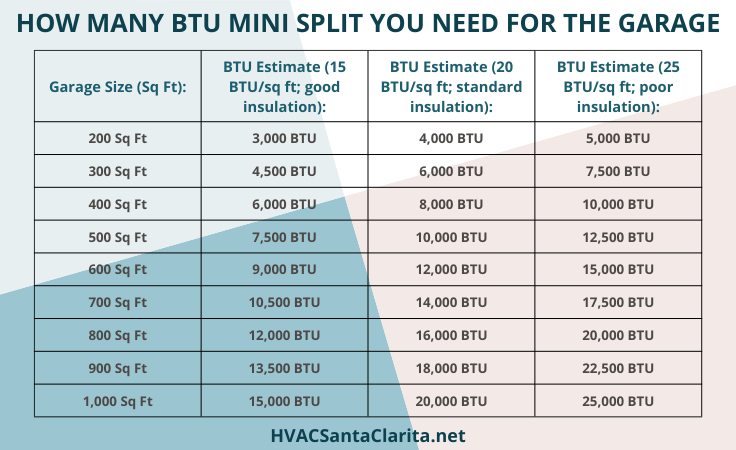
Image Source: hvacsantaclarita.net
Factors Affecting Garage Heating Requirements
Think of your garage as its own microclimate. Many things can influence how much heat it needs. Let’s break down the key elements that impact your garage heating requirements.
Garage Size and Volume
This is the most straightforward factor. A larger space naturally requires more heat to reach and maintain a desired temperature. For a 2-car garage, we’re typically looking at dimensions around 20 feet by 20 feet, giving us 400 square feet of floor space. However, some garages are longer or wider.
Garage Volume Calculation:
To get a more precise idea, consider the volume:
- Length x Width x Height = Volume (cubic feet)
A standard 8-foot ceiling is common, but some garages have higher ceilings, especially if they have an attached living space above or a vaulted design. A higher ceiling means more air to heat.
Insulation Levels
This is perhaps the most significant factor after size. Garage insulation and heating are directly linked. An uninsulated garage is like trying to warm your house with the windows wide open. Heat escapes quickly.
- Uninsulated: Expect significantly higher Btu needs. Walls, ceiling, and doors will be major heat loss points.
- Partially Insulated: Insulation in the walls or ceiling only. Better than nothing, but still considerable heat loss.
- Fully Insulated: Walls, ceiling, and insulated doors. This dramatically reduces heat loss and lowers the required Btu.
The type and R-value (a measure of thermal resistance) of your insulation play a role. More insulation means less heat loss, thus lower heating demand.
Climate and Outdoor Temperature
Where you live matters. If you’re in a region with frigid winters and consistently low temperatures, your heating system will need to work much harder than in a milder climate.
- Extreme Cold: Requires a higher Btu output to combat the large temperature difference between inside and outside.
- Mild Cold: Less demand. The system won’t need to run as constantly.
You’ll want to consider the design temperature for your area – the lowest expected temperature over a typical winter.
Garage Door Quality and Sealing
Garage doors are notorious for being poorly insulated. A single-pane metal door offers very little resistance to heat transfer.
- Insulated Doors: Significantly reduce heat loss.
- Weather Stripping: Proper sealing around the door jambs and bottom can prevent drafts, which are major sources of heat loss.
Air Leakage and Drafts
Beyond the main garage door, think about other potential entry points for cold air:
- Windows: If your garage has windows, are they single or double-paned? Are they well-sealed?
- Access Doors: Doors leading into your house or other parts of your home need to be insulated and properly sealed.
- Wall Penetrations: Any holes where pipes, wires, or vents pass through walls or the ceiling can be sources of drafts.
Desired Internal Temperature
What temperature do you want to maintain? A comfortable workshop might need 60-70°F (15-21°C), while simply preventing freezing might only require 40-50°F (4-10°C). The greater the temperature difference you want to achieve, the higher the Btu requirement.
Usage Patterns
Will the garage be heated constantly, or only when you’re actively using it?
- Constant Heating: Requires a system that can maintain a steady temperature efficiently.
- Intermittent Heating: You might opt for a system that can quickly raise the temperature when needed, even if it requires a higher initial Btu output.
Calculating Your Garage’s Btu Needs: A Step-by-Step Approach
Now that we’ve looked at the factors, let’s get down to brass tacks. How do you actually calculate the Btu?
The Rough Estimate: Square Footage Method
A very basic starting point is to use a square footage multiplier. This is a quick way to get a ballpark figure, but it’s not very accurate on its own.
- For well-insulated spaces: 10-20 Btu per square foot.
- For moderately insulated spaces: 20-30 Btu per square foot.
- For poorly insulated or uninsulated spaces: 30-40+ Btu per square foot.
Example for a 20ft x 20ft (400 sq ft) garage:
- Well-Insulated: 400 sq ft x 20 Btu/sq ft = 8,000 Btu
- Moderately Insulated: 400 sq ft x 30 Btu/sq ft = 12,000 Btu
- Uninsulated: 400 sq ft x 40 Btu/sq ft = 16,000 Btu
Remember, this is a starting point. We need to refine this.
Incorporating Volume and Insulation: The Engineering Approach
A more accurate method involves considering the volume of air and the rate of heat loss. While complex engineering formulas exist, we can use simplified calculations often found in HVAC resources or available through online tools.
Key Concept: Heat Loss
Heating a space is essentially about replacing the heat that is lost to the colder environment. The rate of heat loss depends on:
- Temperature Difference (ΔT): The difference between the desired inside temperature and the coldest expected outside temperature.
- Surface Area: The total area of the walls, ceiling, floor, and doors.
- Material Properties (R-value/U-value): How well these surfaces resist heat flow.
- Air Infiltration: Heat lost through drafts and air exchange.
Using a Garage BTU Calculator
The easiest and often most reliable way to get a precise number for your garage HVAC sizing is to use a dedicated Garage BTU calculator. These tools are designed to factor in all the variables we’ve discussed. Many HVAC manufacturers and online resources offer them.
When using a calculator, you’ll typically input:
- Garage dimensions (length, width, height)
- Location (which helps determine climate and design temperatures)
- Insulation levels (walls, ceiling, floor, doors)
- Window and door types and sizes
- Desired indoor temperature
- Presence of an attached dwelling
These calculators often use established formulas from organizations like ASHRAE (American Society of Heating, Refrigerating and Air-Conditioning Engineers).
A Simplified Calculation Example (for illustration, not definitive)
Let’s try to build a slightly more detailed estimate for a 20ft x 20ft x 8ft (400 sq ft floor, 6,400 cubic ft volume) garage, assuming a desired indoor temperature of 60°F and a design outdoor temperature of 0°F (ΔT = 60°F).
1. Heat Loss through Surfaces (Walls, Ceiling, Floor):
We’ll assign a hypothetical U-value (inverse of R-value) to different construction types. For simplicity, let’s assume:
- Walls (insulated): U-value of 0.06
- Ceiling (insulated): U-value of 0.04
- Floor (uninsulated slab): U-value of 0.10 (Heat loss to the ground is complex, this is a simplification)
We need the surface areas:
- Walls: (20ft + 20ft + 20ft + 20ft) * 8ft = 80ft * 8ft = 640 sq ft
- Ceiling: 20ft * 20ft = 400 sq ft
-
Floor: 20ft * 20ft = 400 sq ft
-
Heat Loss (Walls): U-value * Area * ΔT = 0.06 * 640 sq ft * 60°F = 2,304 Btu/hr
- Heat Loss (Ceiling): U-value * Area * ΔT = 0.04 * 400 sq ft * 60°F = 960 Btu/hr
- Heat Loss (Floor): U-value * Area * ΔT = 0.10 * 400 sq ft * 60°F = 2,400 Btu/hr
- Total Surface Loss: 2,304 + 960 + 2,400 = 5,664 Btu/hr
2. Heat Loss through Doors and Windows:
This is where it gets tricky without specifics. Let’s assume:
- One standard 16ft x 7ft uninsulated garage door: U-value of 0.6 (very poor insulation)
- Area = 16ft * 7ft = 112 sq ft
- Heat Loss (Door) = 0.6 * 112 sq ft * 60°F = 4,032 Btu/hr
- One small single-pane window (2ft x 3ft): U-value of 1.0
- Area = 2ft * 3ft = 6 sq ft
- Heat Loss (Window) = 1.0 * 6 sq ft * 60°F = 360 Btu/hr
3. Heat Loss through Air Infiltration (Drafts):
This is often estimated based on the volume of air exchanged per hour. For an uninsulated or poorly sealed garage, this can be significant. A common factor is the Air Changes per Hour (ACH).
- Uninsulated/Poorly Sealed Garage: 1.0 ACH is a reasonable estimate.
- Insulated/Well-Sealed Garage: 0.3 – 0.5 ACH.
Let’s assume 1.0 ACH for our uninsulated example.
- Heat Loss (Infiltration): Volume (cu ft) * ACH * 0.018 (a factor for air density and specific heat) * ΔT
- Heat Loss (Infiltration): 6,400 cu ft * 1.0 ACH * 0.018 Btu/cu ft/°F * 60°F = 6,912 Btu/hr
4. Total Estimated Heat Loss:
Summing up all our estimates:
- Total Loss: 5,664 (surfaces) + 4,032 (door) + 360 (window) + 6,912 (infiltration) = 16,968 Btu/hr
This rough calculation suggests a need of around 17,000 Btu/hr for an uninsulated garage in these conditions. This aligns with the higher end of our initial square footage estimate.
Adjusting for Insulation and Sealing
Now, let’s see how adding insulation changes things.
Scenario 2: Well-Insulated Garage (20x20x8 ft)
- Walls (R-13 insulation): U-value approx. 0.04 (assuming sheathing, vapor barrier, etc.)
- Ceiling (R-19 insulation): U-value approx. 0.03
- Floor (uninsulated slab): U-value 0.10 (no change)
- One Insulated Garage Door (R-10): U-value approx. 0.20
- One double-pane window: U-value approx. 0.5
- Air Infiltration: Assume 0.5 ACH due to better sealing.
Recalculating:
- Heat Loss (Walls): 0.04 * 640 sq ft * 60°F = 1,536 Btu/hr
- Heat Loss (Ceiling): 0.03 * 400 sq ft * 60°F = 720 Btu/hr
- Heat Loss (Floor): 0.10 * 400 sq ft * 60°F = 2,400 Btu/hr
-
Total Surface Loss: 1,536 + 720 + 2,400 = 4,656 Btu/hr
-
Heat Loss (Insulated Door): 0.20 * 112 sq ft * 60°F = 1,344 Btu/hr
-
Heat Loss (Double-Pane Window): 0.5 * 6 sq ft * 60°F = 180 Btu/hr
-
Heat Loss (Infiltration): 6,400 cu ft * 0.5 ACH * 0.018 * 60°F = 3,456 Btu/hr
-
Total Estimated Heat Loss (Insulated): 4,656 + 1,344 + 180 + 3,456 = 9,636 Btu/hr
This shows a dramatic reduction, from ~17,000 Btu/hr to under 10,000 Btu/hr, simply by improving insulation and sealing. This is why focusing on garage insulation and heating efficiency upfront is so important.
Safety Margins and Buffers
Once you have your calculated heat loss, it’s standard practice to add a safety margin (often 10-20%) to account for unexpected cold snaps, variations in construction, and to ensure the heating system doesn’t have to run at its absolute maximum capacity all the time, which can reduce its lifespan.
So, for our insulated example needing 9,636 Btu/hr, adding a 15% buffer:
9,636 Btu/hr * 1.15 = 11,081 Btu/hr
This would suggest looking for a heater around the 12,000 Btu/hr mark for this well-insulated garage.
Choosing the Best Heater for Your 2-Car Garage
With your Garage BTU calculator results or refined estimates in hand, you can now look for the best heater for a 2-car garage. Several types of heaters are suitable, each with pros and cons.
Electric Heaters
- Infrared Heaters: These work by heating objects and people directly, rather than the air. They can be very effective for spot heating or in spaces where drafts are common.
- Pros: Fast, efficient for direct heat, quiet.
- Cons: Can be expensive to operate for whole-space heating, may require specialized wiring for higher outputs.
- Convection Heaters (Panel Heaters, Baseboard Heaters): These heat the air, which then circulates through the space.
- Pros: Relatively inexpensive to purchase, quiet operation.
- Cons: Slower to heat the entire space, can be less efficient if there are significant drafts.
- Forced Air Electric Heaters (Space Heaters): These use a fan to blow air over a heating element.
- Pros: Quick to heat a space, portable (smaller units).
- Cons: Can be noisy, can dry out the air, electricity costs can be high for continuous use.
Important Note on Electric Heaters: Electric heaters provide 100% of their rated Btu as heat. For example, a 5,000 Btu electric heater will deliver 5,000 Btu/hr. However, they are generally more expensive to run per Btu than gas heaters.
Propane or Natural Gas Heaters
- Vented Gas Heaters: These are connected to a flue or vent to exhaust combustion byproducts safely outside.
- Pros: Very efficient and cost-effective to operate in colder climates, provide robust heating.
- Cons: Require professional installation, venting, and a gas line or propane tank.
- Vent-Free Gas Heaters: These do not require venting, meaning combustion byproducts are released into the garage.
- Pros: Easy to install, don’t need venting.
- Cons: Safety concerns. They consume oxygen and release moisture and carbon monoxide. Require adequate ventilation and must have a CO detector. Often not recommended for living spaces, but can be used in garages with proper precautions. They also add humidity to the air.
Important Note on Gas Heaters: Gas heaters are rated by their input Btu, and their output Btu is slightly lower due to efficiency losses. For example, a 10,000 Btu/hr input gas heater might deliver around 8,000-9,000 Btu/hr of heat.
Garage-Specific Heaters
- Garage Unit Heaters: Often suspended from the ceiling, these can be electric, gas, or propane. They typically have fans to distribute warm air effectively.
- Pros: Designed for garages, good heat distribution, available in various fuel types.
- Cons: Can be more expensive upfront, require appropriate installation.
Infrared Tube Heaters (Gas or Electric)
These consist of a tube that heats up and radiates heat downwards.
- Pros: Excellent for large, open spaces like garages; heat objects directly, reducing heat loss from air circulation; energy efficient.
- Cons: Require professional installation (especially gas units), higher upfront cost.
What about a Mini-Split Heat Pump?
While more commonly used for living spaces, a ductless mini-split can also be an option for a garage.
- Pros: Highly energy-efficient, provides both heating and cooling, can offer precise garage temperature regulation.
- Cons: Higher upfront cost, requires professional installation, performance in extreme cold can vary depending on the model (look for cold-climate versions).
Optimizing Garage Heating Efficiency
Choosing the right Btu is only part of the puzzle. Maximizing Garage heating efficiency ensures you get the most out of your system and keep costs down.
The Power of Insulation
We can’t stress this enough: garage insulation and heating are inseparable. Investing in good insulation for walls, ceiling, and especially the garage door will significantly reduce your heating needs and the size of the heater required.
- Attic Insulation: If you have living space above the garage, insulate the ceiling well.
- Wall Insulation: Consider R-13 or R-19 insulation for the walls.
- Garage Door Insulation: Replace old doors with insulated ones or add insulation panels to your existing door.
- Weather Stripping: Seal all gaps around doors and windows.
Sealing Air Leaks
Walk around your garage on a cold, windy day with a lit incense stick or a thermal leak detector. Any area where the smoke or color changes indicates a draft. Seal these with caulk or spray foam. Pay special attention to:
- Around windows and doors
- Where walls meet the foundation
- Around any pipes or electrical conduits entering the garage
Using a Thermostat and Timer
Installing a thermostat allows you to set and maintain a desired temperature. This prevents the heater from running unnecessarily. A programmable thermostat or a timer can further enhance efficiency by only heating the garage when you need it. This is key for good garage climate control.
Zone Heating vs. Whole-Space Heating
If you only need to heat a specific area of your garage (e.g., a workbench area), consider targeted heating solutions like infrared radiant heaters. These can be more efficient than trying to heat the entire volume of air.
Common Pitfalls to Avoid
- Oversizing the Heater: A heater that’s too large will cycle on and off frequently, leading to uneven temperatures, increased wear on the unit, and wasted energy. It might also be more expensive to purchase.
- Undersizing the Heater: The heater will struggle to reach or maintain the desired temperature, running constantly and potentially wearing out faster.
- Ignoring Insulation: Trying to heat an uninsulated space is like pouring money into a leaky bucket.
- Poor Ventilation with Gas Heaters: This is a serious safety hazard. Always ensure proper ventilation and CO detectors if using any fuel-burning appliance indoors.
- Forgetting about Cooling: In warmer climates, if you also want to use the garage for comfort during summer, consider a system that offers cooling (like a mini-split) or a dual-purpose unit.
Frequently Asked Questions (FAQ)
Q: What is the minimum Btu needed for a 2-car garage?
A: For simply preventing freezing in a moderately insulated 2-car garage, you might get away with as little as 3,000-5,000 Btu/hr, but this is very minimal and dependent on climate and insulation. For any level of comfort, the range is much higher.
Q: Can I use a portable space heater in my garage?
A: Yes, portable electric space heaters are common for garages, especially for occasional use. Ensure they are rated for the size of your space and that your electrical circuit can handle the load. For frequent use or larger spaces, a dedicated installed heater is usually more efficient and safer.
Q: Is it expensive to heat a 2-car garage?
A: It depends heavily on insulation, climate, the type of heater used, and your desired temperature. Heating an uninsulated garage in a cold climate with electricity can be quite expensive. Insulating well and using an efficient heater (like gas if available) can significantly reduce costs.
Q: Should my garage be as warm as my house?
A: Not necessarily. Most people aim for a lower temperature in the garage, perhaps 45-60°F (7-15°C), especially if it’s not a primary living or working space. This saves energy. If you plan to spend extended periods working or living in the garage, you might aim for higher temperatures.
Q: How do I calculate Btu for a large 2-car garage (e.g., 24ft x 24ft)?
A: The principles remain the same. Use the increased dimensions to calculate volume and surface area. A larger garage will require a higher Btu output. Using a specialized Garage BTU calculator is highly recommended for larger or unusually shaped spaces.
Q: What is the best heater for a 2-car garage in a very cold climate?
A: In very cold climates, vented gas unit heaters or infrared tube heaters are often the most effective and cost-efficient options for providing substantial heat. Electric heaters can be an option if gas isn’t feasible, but electricity costs will be higher.
By carefully considering all these factors and using available tools, you can accurately determine the right Btu for your 2-car garage, ensuring a comfortable and energy-efficient garage climate control solution.