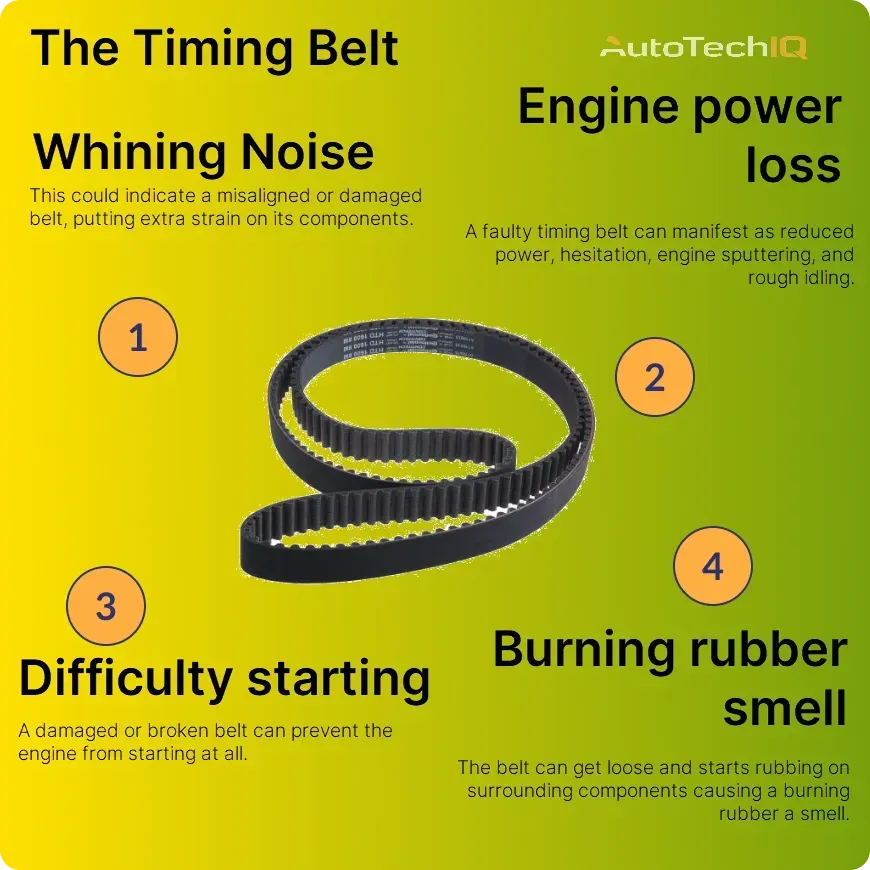
Image Source: www.autotechiq.com
Car Won’t Start: Can Timing Belt Cause Car Not To Start?
Yes, absolutely, a timing belt can cause a car not to start. In fact, a failed timing belt is a very common reason for a car to crank but not actually run the engine itself. The timing belt is a critical part of your car’s engine. If it breaks or slips, the engine cannot work correctly and will likely not start at all.
Deciphering the Timing Belt’s Job
Think of your engine like a complex dance. Inside, there are parts moving up and down very fast. These are the pistons. There are also parts opening and closing. These are the valves. The valves let air and fuel into the engine and let out the exhaust gas.
The Engine’s Internal Dance
The pistons go up and down in cylinders. When a piston goes down, a valve needs to open to let fuel and air in. When the piston comes up, that valve must be closed so the piston can squeeze the fuel and air mix. Then the spark plug fires. This makes a small explosion. The explosion pushes the piston back down. Then another valve opens to let the burnt gas out as the piston comes up again. This whole process happens thousands of times a minute when your car is running.
The Belt as the Conductor
This complex dance needs perfect timing. The valves must open and close at exactly the right time as the pistons move. If the timing is off, even a little bit, the engine will not work right.
The timing belt is like the conductor of this engine dance. It is a strong, toothed rubber belt. It connects the crankshaft (the main spinning part the pistons connect to) to the camshaft (the spinning part that opens and closes the valves). As the crankshaft turns, the timing belt makes the camshaft turn at the correct speed and at the correct time. This ensures the valves open and close in perfect sync with the pistons’ movement.
When the Beat Stops: Timing Belt Failure
Timing belts do not last forever. They are made of rubber and cords. Over time, they wear out. They can crack, fray, or lose their teeth.
What Causes Failure?
The main cause of timing belt failure is simply age and wear. The rubber gets old and brittle. Heat from the engine and constant use weaken it.
Other things can cause failure:
* Oil or fluid leaks dripping onto the belt. This can make the rubber break down fast.
* A bad tensioner or idler pulley. These parts keep the belt tight and guide it. If they fail, the belt can become loose, slip, or even break.
* Putting in a poor-quality belt during a past replacement.
* Incorrect installation of the belt.
Sudden Break or Slow Slip?
Timing belts can fail in two main ways:
- Breaking: The belt snaps completely. This is often sudden and happens without much warning. When the belt breaks, the connection between the crankshaft and camshaft is lost instantly. The camshaft stops turning (or spins freely), and the valves freeze in whatever position they were in. The crankshaft might keep spinning for a moment because of the car’s momentum if you were driving.
- Slipping: The belt’s teeth wear down, or the belt becomes loose. It might jump a tooth or two on the gears it connects to. This means the camshaft gets out of sync with the crankshaft. The valves still move, but they open and close at the wrong time relative to the pistons.
Both breaking and slipping can cause a timing belt failure starting problem.
Grasping Why Failure Prevents Starting
Now let’s look at why a bad timing belt stops your car from starting.
The Critical Link to Ignition
For an engine to run, you need three main things happening at the right time:
1. Fuel and air mixing in the cylinder.
2. The mix being squeezed tightly (compression).
3. A spark plug firing to light the mix.
The timing belt plays a direct role in steps 1, 2, and indirectly affects 3. The valves, controlled by the belt, let the fuel/air in and out. The correct timing ensures the valves are closed when the piston comes up to squeeze the mix (compression). The engine computer also uses the timing belt’s actions (sensed by sensors) to know when to fire the spark plug.
If the belt breaks or slips badly, the valves stop opening and closing at the right time.
No Compression Engine Timing Belt Explained Simply
When the timing belt breaks or slips a lot, the valves no longer move in sync with the pistons.
- Broken belt: The valves just stop. Some might be open, some closed. As the starter motor tries to turn the engine, the pistons still move up and down. If a valve is open when a piston comes up, the air/fuel mix cannot be squeezed. It just pushes back out through the open valve. There is no compression.
- Slipped belt: The valves still move, but they are opening and closing at the wrong time. A valve might still be slightly open when the piston comes up. Again, the air/fuel mix escapes, and you lose compression.
Compression is needed for the tiny explosion that powers the engine. If there is no compression engine timing belt failure is the likely cause. The engine will crank (turn over) when you turn the key, but it won’t start because it can’t build pressure inside the cylinders. This is a classic timing belt broken no start symptom.
Car Cranks But Won't Start Timing Belt Scenario
This is perhaps the most common outcome of timing belt failure while the car is not running or trying to start. You turn the key, you hear the starter motor whirring and spinning the engine – that’s the “cranking” part. But the engine doesn’t catch and run on its own.
Why? Because even though the starter is turning the crankshaft, the broken or slipped timing belt means the camshaft isn’t turning correctly. The valves are not letting air/fuel in, or they are open at the wrong time, causing no compression engine timing belt. Without that vital compression and correct timing for spark, the engine just spins uselessly.
This car cranks but won't start timing belt issue is a strong indicator that something is fundamentally wrong with the engine’s ability to perform its basic combustion cycle, often pointing to a timing system problem like a broken or badly slipped belt.
Timing Belt Broken No Start: The Direct Result
If your timing belt breaks, your engine will instantly stop running if it was on. If you try to start it afterward, it will simply crank but not catch. A timing belt broken no start condition is the most common outcome of a complete belt failure. The crankshaft spins, but the camshaft is disconnected or stationary. The engine timing is totally lost.
Spotting the Signs: Broken Timing Belt Symptoms and Slipped Timing Belt Symptoms
Sometimes a timing belt gives you a warning sign before it breaks completely. Often, though, failure is sudden. Knowing the broken timing belt symptoms and slipped timing belt symptoms can help you know what’s happening.
Before It Breaks Completely (If You’re Lucky)
A timing belt that is wearing out or starting to slip might cause some issues before complete failure.
- Strange noises: A whining or ticking noise from the front of the engine. This might be the belt rubbing, or a failing tensioner or pulley.
- Engine misfires: The engine might run rough, shake, or feel like it’s losing power sometimes. This can happen if the belt has slipped a tooth or two, causing the timing to be slightly off. The engine computer detects that cylinders are not firing correctly.
- Check Engine light: A misfire or timing issue can trigger the Check Engine light. The engine computer sees that the signals from sensors (like the crankshaft and camshaft sensors) don’t match up right.
- Difficulty starting sometimes: Before a complete no-start, you might notice the engine takes longer to start on occasion.
After Complete Failure
If the timing belt breaks completely, the broken timing belt symptoms are usually dramatic:
- Engine stops suddenly: If you were driving, the engine will just die. It won’t sputter or slow down gradually; it just stops.
- Engine won’t restart: When you try to start it again, you will experience the
car cranks but won't start timing beltproblem described earlier. You’ll hear the starter, but no engine running sound. - No compression: As explained, a broken belt means
no compression engine timing belt. A mechanic can test this. - Internal engine noise (sometimes): In interference engines (more on this next), a broken belt can cause parts inside the engine to hit each other. This might create loud, clanking, or grinding sounds when the belt breaks or when you try to crank the engine.
Key Symptoms in a List
Here are common signs related to timing belt failure starting problem:
Car cranks but won't start timing beltis the main symptom after failure.- Engine stops suddenly while driving.
- Loud noise from the engine (if internal damage happened).
- Engine runs rough or misfires before complete failure (
slipped timing belt symptoms). - Check Engine light comes on (can be for misfires or timing codes).
- You can’t feel compression when turning the engine by hand (this is a mechanic’s test).
- Visibly broken or frayed belt (if you can see it easily).
Table: Common Timing Belt Symptoms
| Symptom | Description | Potential Cause | Urgency |
|---|---|---|---|
| Engine Won’t Start | Starter spins the engine, but it doesn’t catch and run (cranks but won't start). |
Broken or badly slipped belt | High |
| Engine Stops Suddenly | Engine dies unexpectedly while driving. | Broken belt | High |
| Rough Engine Running | Engine shakes, feels weak, misfires (slipped timing belt symptoms). |
Belt slipping, timing slightly off | Medium/High |
| Strange Engine Noises | Whining, ticking, or grinding from front of engine. | Belt, tensioner, or pulley issue | Medium |
| Check Engine Light On | Computer detects misfire or timing fault. | Slipped belt, sensor issue | Medium/High |
| No Compression (Test) | Engine can’t build pressure in cylinders. | Broken or badly slipped belt | High |
| Loud Bang/Grind When Belt Breaks | If internal parts hit. | Broken belt in interference engine | High |
Interpreting Potential Engine Damage Timing Belt Failure
One of the scariest things about timing belt failure is the possibility of major internal engine damage. This depends on the type of engine your car has.
What are Interference and Non-Interference Engines?
Car engines are designed in different ways.
* Non-Interference Engine: In this type of engine, the parts are designed so that even when the valves are fully open and the pistons are at their highest point, they never occupy the exact same space. There’s always clearance.
* Interference Engine: In this type of engine, the valves and pistons do share space in the cylinder at different times during the engine cycle. The timing belt’s job is to make sure they never try to occupy that shared space at the same time. The belt keeps the valves out of the way of the rising pistons.
You usually need to look up whether your specific car model and engine are interference or non-interference. Most modern engines are interference designs because they can be more efficient and powerful.
The Risk in Interference Engines
If a timing belt breaks or slips significantly on an interference engine, the carefully choreographed dance is ruined. A piston will likely come up while a valve is still open.
What happens then?
* The piston smacks into the valve (like two hard objects colliding).
* This collision can bend the valve stem.
* It can damage the piston head.
* It can damage the cylinder head where the valve sits.
* In severe cases, it can break parts of the camshaft or crankshaft.
This is engine damage timing belt failure. It turns a relatively simple belt replacement job into a very expensive engine repair, possibly requiring a cylinder head rebuild or even a complete engine replacement. This is why replacing the timing belt before it breaks is crucial, especially with interference engines. A broken belt doesn’t always mean damage (if it’s a non-interference engine), but it’s a high risk in many cars today.
The Role of Sensors: Crankshaft Position Sensor Timing Belt and Camshaft Position Sensor Timing Belt
Modern cars have computers (Engine Control Units, or ECUs) that manage many engine functions, including spark timing and fuel injection. These computers need to know exactly what the engine is doing at all times.
How Sensors Monitor Timing
This is where the crankshaft position sensor timing belt and camshaft position sensor timing belt come in.
* The Crankshaft Position Sensor (CKP) watches a special ring on the crankshaft. It tells the computer how fast the crankshaft is spinning and exactly where it is in its rotation. This tells the computer the position of the pistons.
* The Camshaft Position Sensor (CMP) watches a special ring on the camshaft. It tells the computer how fast the camshaft is spinning and exactly where it is in its rotation. This tells the computer the position of the valves.
The engine computer constantly compares the signals from the CKP and CMP sensors. It knows the crankshaft and camshaft must turn in a specific ratio (usually 2:1, crankshaft spins twice for every one camshaft spin) and stay perfectly aligned in their rotation based on the timing belt.
If the timing belt breaks, the CKP sensor will show the crankshaft spinning, but the CMP sensor will show the camshaft stopped or spinning randomly. The computer immediately sees that the timing is completely off.
If the timing belt slips even just a little, the computer sees that the crankshaft and camshaft signals are out of their correct alignment. The computer knows the timing is wrong.
Sensor Issues vs. Belt Issues
Sometimes, a bad CKP or CMP sensor can mimic a timing belt problem because the computer isn’t getting the correct information about the crankshaft or camshaft position. A bad sensor can cause a car cranks but won't start timing belt symptom because the computer doesn’t know when to fire the spark plugs or inject fuel.
However, a mechanic can usually tell the difference. They can test the sensors directly. They can also physically check the timing belt and see if it’s broken or has slipped marks. Checking for no compression engine timing belt failure is also a key diagnostic step. If there’s no compression and the sensors seem okay, the timing belt is the prime suspect.
Addressing Timing Belt Failure Starting Problem
So, you turn the key, the car cranks, but it won’t start. You suspect a timing belt failure starting problem. What happens next?
Diagnosis: Finding the Real Reason
You need a mechanic to properly diagnose the issue. They will:
1. Listen to the engine cranking. Does it sound normal? (A broken belt might make the engine crank very easily, almost too fast, because there’s no compression resistance).
2. Check for trouble codes using a scan tool. Codes related to crankshaft/camshaft correlation or misfires point towards timing issues.
3. Inspect the timing belt visually (if possible on your engine). Is it broken? Does it look worn?
4. Perform a compression test. This checks if the cylinders can hold pressure. No compression engine timing belt failure is confirmed by this test.
5. Check the timing marks on the crankshaft and camshaft gears to see if they are aligned correctly (to see if the belt has slipped).
6. Test the crankshaft position sensor and camshaft position sensor.
Based on these tests, they can confirm if the timing belt is the problem.
Repair: Timing Belt Replacement No Start
If the timing belt is broken or slipped, the repair involves replacing the belt. This is often done with the tensioner and idler pulleys, and sometimes the water pump, as these parts wear out at similar rates and are located behind the same covers.
However, replacing the timing belt does not guarantee the car will start, especially if it’s an interference engine.
* If there was no engine damage: Replacing the belt (and related parts) should fix the timing belt broken no start issue. With the new belt on and timed correctly, the engine should regain compression and start.
* If there was engine damage: If pistons hit valves, replacing just the belt won’t help. The bent valves or damaged cylinder head will still prevent the engine from building compression. In this case, the engine itself needs repairs before it can start. This is a much bigger and more expensive job. This is why a car might still be timing belt replacement no start if the damage is not fixed.
A good mechanic will usually check for potential damage before or immediately after removing the old belt if failure is suspected, especially on interference engines.
Preventing Timing Belt Troubles
The best way to avoid a timing belt failure starting problem and potential expensive engine damage is to replace the belt before it breaks.
Why Replace on Time?
Timing belts don’t give long warning signs like squealing fan belts might. They often look fine right up until they fail. Because the consequences of failure are so severe (especially in interference engines), preventative replacement is key.
Replacing the belt at the recommended interval is much cheaper than repairing or replacing an engine damaged by belt failure.
Finding Your Car’s Schedule
Every car manufacturer has a recommended schedule for when to replace the timing belt. This is usually listed in your car’s owner’s manual under the maintenance section.
The interval is typically based on mileage or time, whichever comes first. For example, a common interval might be every 60,000 to 100,000 miles, or every 5 to 7 years. It varies a lot by car model and year.
Table: Example Timing Belt Replacement Intervals (Check Your Manual!)
| Car Make/Model Example | Engine Type Example | Approx. Interval (Miles) | Approx. Interval (Years) | Interference Engine? |
|---|---|---|---|---|
| Honda Civic (Older) | 1.6L 4-cylinder | 60,000 – 90,000 | 6-7 | Yes |
| Toyota Camry (Older) | 2.2L 4-cylinder | 60,000 – 90,000 | 6-7 | Yes |
| Subaru Outback (Older) | 2.5L 4-cylinder | 105,000 | 10 | Yes |
| Volkswagen Jetta | 2.0L TDI (Older) | 80,000 – 100,000 | 6-7 | Yes |
| Ford Focus (Older) | 2.0L 4-cylinder | 60,000 – 100,000 | 6-7 | Yes |
Note: These are just examples. Your car’s exact model, year, and engine are important. Always check your specific owner’s manual or ask a trusted mechanic.
It’s also a good idea to replace the tensioner, idler pulleys, and sometimes the water pump at the same time. These parts are right there when the belt is replaced, and their failure can also lead to belt problems. Doing it all at once saves labor costs compared to doing them separately later.
In Conclusion
Yes, a bad timing belt is a definite cause for a car not to start. It stops the engine’s internal parts from moving in sync. This leads to no compression engine timing belt problems. The result is often a car cranks but won't start timing belt symptom. If your belt breaks, you will face a timing belt broken no start situation. Ignoring replacement can lead to a timing belt failure starting problem and possibly expensive engine damage timing belt failure. Pay attention to potential broken timing belt symptoms or slipped timing belt symptoms. Check your car’s manual for the recommended replacement time. This simple maintenance step can save you a lot of trouble and money down the road. The crankshaft position sensor timing belt and camshaft position sensor timing belt are key parts the car’s computer uses to monitor this critical timing. If these sensors detect the timing is off because of a belt issue, the car won’t start.
Frequently Asked Questions (FAQ)
H4: What does it mean when a car cranks but won’t start?
When a car cranks but won’t start, it means the starter motor is working and turning the engine over. But the engine itself isn’t running on its own power. It’s not firing up. This often means the engine isn’t getting fuel, spark, or compression at the right time. A bad timing belt stops the compression and timing, causing this issue.
H4: Can a car’s timing belt break while driving?
Yes, a timing belt can break while you are driving. If it breaks, the engine will suddenly stop. You will lose power steering and power brakes (though you can still steer and brake, it will be much harder).
H4: If my timing belt broke, is my engine ruined?
It depends on your engine type. If you have a non-interference engine, a broken belt usually just means the car stops and won’t restart until the belt is replaced. There is no internal contact. If you have an interference engine (most modern cars), there is a high chance of internal damage like bent valves or damaged pistons when the belt breaks.
H4: How long does a timing belt usually last?
The lifespan varies greatly by car make and model. It’s usually recommended to replace it between 60,000 and 100,000 miles, or after 5 to 7 years, whichever comes first. Always check your car’s specific owner’s manual for the exact recommended interval.
H4: Is replacing a timing belt expensive?
Replacing a timing belt involves significant labor because it’s often hard to reach. The cost varies by vehicle, but it can range from a few hundred dollars to over a thousand, especially if other parts like the water pump, tensioner, and pulleys are replaced at the same time (which is recommended). This is much cheaper than fixing an engine damaged by a broken belt.
H4: Can a slipped timing belt cause a car not to start?
Yes. If a timing belt slips enough teeth, the timing between the crankshaft and camshaft will be off significantly. This can cause the engine to lose compression or for the spark to happen at the wrong time. The result is often a car that cranks but won’t start. Even a slight slip can cause rough running or a check engine light.
H4: How can I tell if my timing belt is bad without taking it apart?
You often can’t see the timing belt easily without removing covers. However, some signs like the engine cranking but not starting, sudden stopping, misfires, or certain trouble codes (especially those related to crankshaft/camshaft correlation) can strongly suggest a timing belt problem. A mechanic can confirm it with tests like a compression test or by checking timing marks.